
Overview
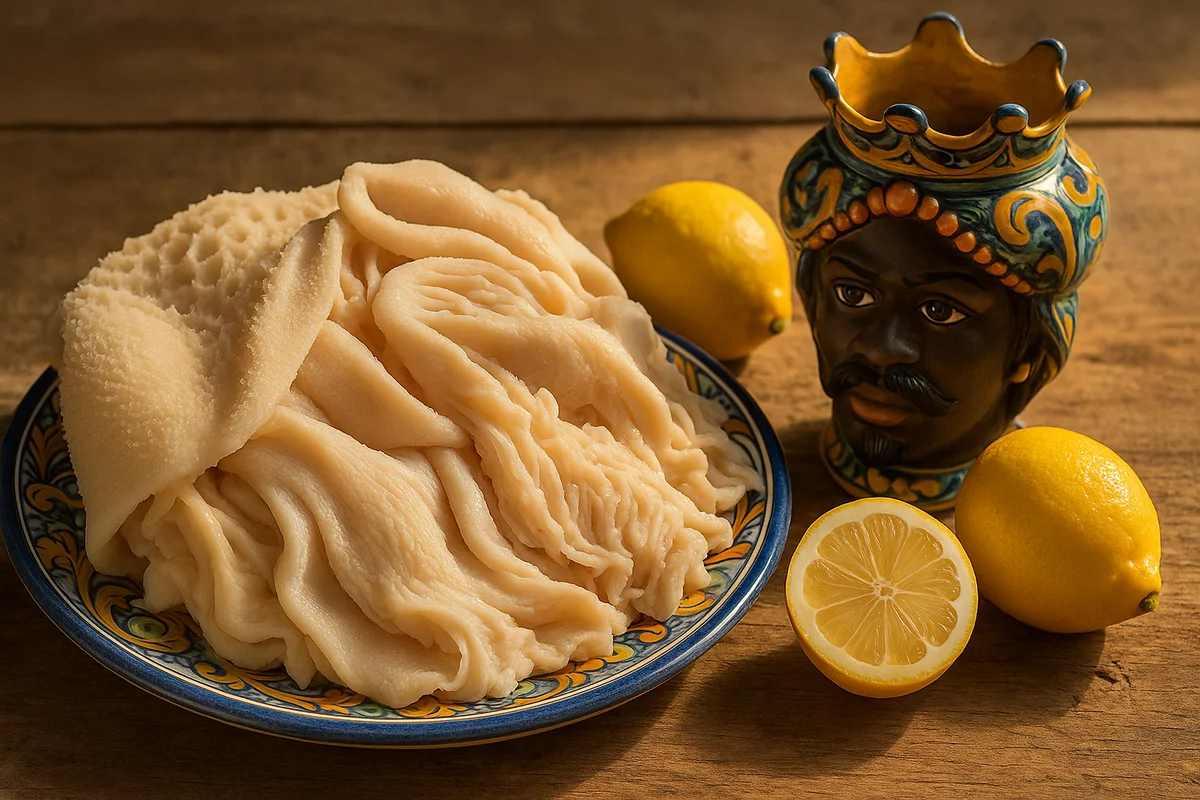
Tripe, known in Sicilian as “trippa” or “càvuci” (a term that can also include other offal), is the stomach of cattle (cows, oxen, veal) prepared for human consumption through thorough cleaning, blanching and pre-cooking. Cattle are ruminants with a complex stomach composed of four chambers: the rumen (or “panza”), the reticulum (or “cuffia”, “bonetto”), the omasum (or “centopelli”, “libro”), and the abomasum (or “francese”, “lampredotto”). All four chambers are edible, each with its own characteristics. In traditional Sicilian cooking, tripe is the basis of humble yet sustaining dishes: tripe stewed with tomato, tripe alla parmigiana, fried tripe. It is—and has always been—people’s food: inexpensive, nourishing, requiring long, careful cooking to become tender, but rewarding with a deeply savoury flavour and singular texture. Tripe embodies thrifty cuisine that wastes nothing, the rural wisdom that transforms modest cuts into memorable dishes.
Preparing tripe demands patience: meticulous cleaning, long cooking times (even 3–4 hours), yet the result is hearty, flavoursome food appreciated by those who love authentic, bold tastes. Tripe is a divisive ingredient: those who love it adore it, while those who have never tried it often shy away from it out of prejudice. In Sicilian collective memory, tripe evokes lively markets where it was sold already cleaned and partially cooked; the distinctive scent filling homes during long simmering; steaming winter dishes that warmed and nourished; popular trattorias where tripe was a house speciality. It is food that connects to rural roots, to respect for the animal, and to the art of creating goodness from humble ingredients.
Characteristics
The different chambers of the bovine stomach each have distinct features:
Rumen (panza): The largest, thickest chamber, with a rough, velvety interior surface covered in papillae. After cleaning, it is cream-white. Once cooked, the texture is tender and slightly chewy. This is the most common type sold as tripe.
Reticulum (cuffia, bonetto): Distinguished by its honeycomb pattern. It has a more delicate texture than the rumen and a slightly finer flavour. It is considered a prized part.
Omasum (centopelli, libro): Formed by many thin overlapping folds (hence “centopelli” and “book”). It has a firmer texture. Less commonly used but appreciated.
Abomasum (francese, lampredotto): The “true” stomach (glandular, similar to the human stomach), smooth and softer. Highly prized in Tuscany for the renowned lampredotto.
Tripe sold at markets is usually already cleaned, whitened and partially pre-cooked. It should be cream-white, with a neutral or lightly characteristic scent, firm yet able to become tender with long, slow cooking.
Preparation and cleaning
Fresh tripe requires lengthy preparation (which is why it is usually bought ready to cook):
1. Repeated washing in water to remove residues.
2. Scraping of the inner membrane and removal of any inedible parts.
3. Whitening (soaking in water with lemon or vinegar for several hours).
4. Long preliminary boiling (2–3 hours) in water with aromatics (celery, carrot, onion) to tenderise it and eliminate strong odours.
5. At this point it is ready to be used in recipes.
Fortunately, Sicilian markets typically sell tripe already cleaned, whitened and pre-cooked. It only needs a final simmer or can be cooked directly in stews.
Use in Sicilian cuisine
Tripe stewed with tomato
The most classic preparation. Sliced tripe is simmered slowly with tomato, onion, celery, carrot, garlic, bay leaf and pepper. Long cooking (2–3 hours) tenderises the tripe and produces a rich sauce. Served hot with bread to mop up the juices.
Tripe alla parmigiana
Tripe cooked in a tomato stew, then layered in a baking dish with grated Parmesan, pecorino and tomato, and baked until gratinated. A substantial, satisfying dish.
Fried tripe
Pieces of boiled tripe are floured and deep-fried until crisp on the outside and soft within. Served hot with lemon. A delicacy for enthusiasts.
Tripe with potatoes
A variation of the stew with the addition of diced potatoes, which absorb the sauce. A hearty one-dish meal.
Tripe with pulses
Tripe cooked with beans, chickpeas or lentils. A winter preparation, nourishing and comforting.
Tripe soup
Finely sliced tripe in a rich broth with vegetables and pulses. A humble yet sustaining dish traditionally eaten on cold evenings.
Perfect cooking of tripe
Tripe requires long, gentle cooking to become tender. Short cooking leaves it tough and rubbery. The necessary time depends on its initial state:
Pre-cooked tripe (purchased): Still needs 1–2 hours of stewing to become soft and absorb flavours.
Raw tripe (rare): Requires 3–4 hours or more of boiling/cooking.
Properly cooked tripe is tender yet retains some bite. It should cut easily with a fork without falling apart.
Storage
Raw or pre-cooked tripe keeps in the refrigerator for 2–3 days, well covered. Its characteristic smell can permeate the fridge, so it must be sealed properly.
Cooked tripe keeps for 3–4 days in the refrigerator in a closed container, ideally covered in its sauce to keep it moist. It reheats well.
Tripe freezes well: cleaned and pre-cooked, portioned, it keeps for 2–3 months. Thaw in the refrigerator before cooking.
Buying tips
Buy tripe from traditional butchers or market stalls where correct cleaning and freshness are guaranteed. It should be white or light cream, not greyish or blotched. The smell should be neutral or mildly characteristic but never strong or unpleasant.
Ensure it is properly cleaned and preferably pre-cooked (this saves hours of preparation). Ask the butcher which chamber it is (rumen, reticulum, etc.) if you have a preference.
Tripe is inexpensive (3–6 euros/kg), part of its charm being the excellent value: with little you can feed several people.
Nutritional properties
Tripe is a lean food: 100g provide around 85–100 calories. It contains 15–17g of good-quality protein, 3–4g of fat and no carbohydrates. It is rich in B vitamins (especially B12) and minerals such as iron, zinc, selenium and phosphorus.
It is easily digestible (once properly cooked), nourishing and filling. Its proteins are mainly collagen, which during long cooking converts into gelatin, giving its characteristic texture.
Compared to other meats, tripe is lower in fat and calories and is considered a lean choice. It fits well into a varied, balanced diet.
Tripe in Sicilian tradition
Tripe has long held its place in Sicilian popular cooking as inexpensive, sustaining food. Rural and working-class families ate it regularly, especially in winter when hearty, warming dishes were needed.
In Sicily’s historic markets (Ballarò in Palermo, the Pescheria in Catania), tripe was sold by specialised vendors who cleaned and prepared offal. It was a lively trade, with regular customers returning for quality tripe.
Popular trattorias often featured tripe on their fixed menus, particularly during the colder months. It was a dish that brought diners together around shared tables, enjoying hearty food and convivial conversation.
Tripe embodied the noble notion of thrift: wasting nothing, valuing every part of the animal, creating goodness through patience and skill.
Tripe in other Italian regions
Tripe is found throughout Italy, with regional variations:
Roman tripe: With tomato, mentuccia (Roman mint) and pecorino. An iconic Roman dish.
Florentine tripe: With tomato and grated Parmesan. Lampredotto (abomasum) boiled and served in a sandwich is a celebrated Florentine street food.
Milanese tripe: With beans, tomato, sage and Parmesan. A winter dish from Lombardy.
Genoese tripe: With potatoes, mushrooms and Parmesan.
Every region has its own recipes, but the principle is the same: long cooking, rich flavours, hearty food.
Curiosities
The word “tripe” probably derives from Old French “tripe”, of uncertain (possibly Germanic) origin. It generically refers to the stomach and intestines of animals used as food.
Tripe is eaten in many cultures worldwide: France (tripes à la mode de Caen), Spain (callos), Mexico (menudo, pancita), China (various preparations), Poland (flaki). It is universal food in cultures that make full use of the animal.
An old saying goes: “Tripe is good for those who can digest it”, a humorous reference to the fact that it is polarising—loved or disliked—and that it requires a strong stomach (in the sense of familiarity with bold flavours).
In some Italian regions, there were “tripe festivals” celebrating this traditional dish. These were moments of community, local pride and the passing down of ancient recipes.
Tripe has been reappraised by contemporary haute cuisine: Michelin-starred chefs prepare it with modern techniques, refined presentations and innovative pairings. It is a prime example of humble food elevated to fine dining while preserving authenticity.
In colloquial speech, “having a full tripe” means being very full, having eaten abundantly. “Doing tripe” (working hard) recalls the labour involved in its preparation.
Ruminants have a complex stomach to digest cellulose (grass, hay), which other animals cannot break down. The four chambers work in sequence: fermentation in the rumen, further breakdown in the others—an extraordinarily efficient system. When we eat tripe, we taste an organ that is an evolutionary marvel.
In pre-industrial economies, tripe was important because every part of a slaughtered animal had value. Industrial abundance led to forgetting this wisdom, but the recent rediscovery of “nose-to-tail eating” honours the animal by using it in its entirety.