Contents
- Some History
- Plant Characteristics
- The Bronte Variety
- The Harvest
- A Key Innovation
- Uses
The Pistachio of Bronte (known locally in Sicilian as frastuca) is a special variety of pistachio cultivated in the countryside around Bronte and Adrano, towns nestled in the province of Catania.
Some History
The pistachio tree (Pistacia vera in scientific terms) has been known in the Middle East since prehistoric times. The Greek writer Athenaeus of Naucratis, from the Hellenistic period, tells us that the bistachion (as the Greeks called it) was widely grown in ancient Persia and even in distant India.
According to Pliny, pistachios arrived in Italy at the start of the 1st century AD, brought back by the censor Lucius Vitellius after his time in Syria. The tree found its way to Sardinia and Sicily, as the Romans believed the Mediterranean climate of the larger islands was ideal for pistachio cultivation.
Pistachio farming in Sicily gained prominence during the Arab conquest of the island; however, paradoxically, production sharply declined under Arab rule. Eastern farmers, unfamiliar with the crop, removed unproductive trees, unaware these seemingly useless trees were actually male pollinators essential for the pistachio’s survival.
This remarkable cultivar nearly vanished, surviving only as a plant of little value. Indeed, during the Middle Ages, the word “pistachio” became a byword for something or someone insignificant.
It was only in the early 20th century that pistachio cultivation was revived in the fields of Bronte; at that time, the island of Trinacria was the world’s leading producer.
Today, pistachio farming thrives again in the Near East, parts of China, and across the Atlantic in California’s orchards.
Plant Characteristics
The tree typically grows to about 5 metres tall, with grey bark and broad, deciduous leaves. It is dioecious, meaning each tree bears flowers of only one sex.
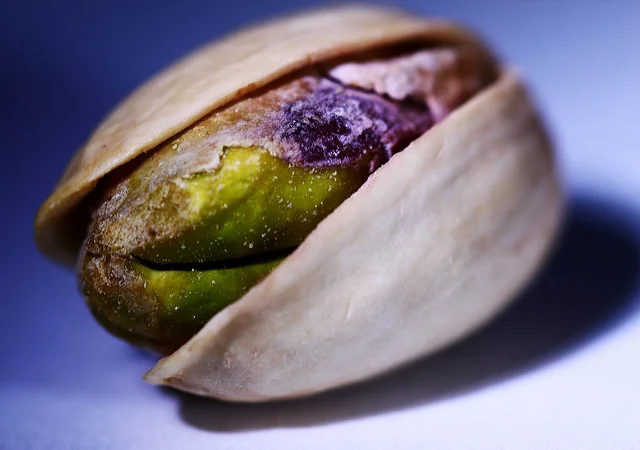
Flowering occurs from late April to early May, with a two-year fruiting cycle. The fruit is a drupe—a fleshy fruit containing a single elongated seed, notable for its vivid green colour, encased in a purple shell.
The Bronte Variety
An important variety is the pistachio of Bronte, affectionately called scornabecco (goat’s horn) by locals.
As mentioned, pistachios arrived in Italy and Sicily thanks to Lucius Vitellius returning from the Middle East. The tree flourished in the volcanic soils of Catania; thus, at the foot of Mount Etna, the Pistachio of Bronte cultivar was born.
Thanks to the Arabs, cultivation took firm root. Evidence of this remains in the local dialect: the term “frastuca” for the pistachio derives from the Arabic “frastuch,” while “frastuchino” describes the nut’s bright green hue.
The Pistachio of Bronte can grow up to 10 metres tall, though growers prune the trees to make harvesting easier.
These trees can live for around 300 years and grow from Bronte to the nearby village of Ragalna, close to the volcano. Remarkably, the pistachio trees can regrow even after lava flows. Another key player is the terebinth shrub, which grows to about 5 metres and produces green or red drupes.
The terebinth serves as a rootstock, enabling the pistachio to thrive even in the most challenging terrain.
The Harvest
The Pistachio of Bronte is harvested every two years, in odd-numbered years. In the off years, known as ‘rest’ years, farmers carry out ‘green pruning’—hand-picking developing drupes to manage the crop.
Harvest begins in early September. If there’s been no rain beforehand, irrigation systems are used. The harvest is still done by hand, with nuts collected in baskets carried on the shoulder or by shaking the branches so the drupes fall onto nets spread beneath the trees.
Immediately after picking, the outer skin around the shell is removed, and the nuts are left to dry in the sun for three to four days to protect against pests.
At this stage, the pistachio—now called tignosella—is sold to wholesalers who shell the nuts.
Until recently, families would shell pistachios at home, using a small hammer (known locally as ‘u sciffu) to crack the shell at the tip without breaking it.
A Key Innovation
After the Second World War, a former general had a clever idea. Noticing the similarity between the pistachio shelling hammer and a pistol, he invented a machine that shelled the tignosella by striking the shells with a piston. Modern producers still use this machine, albeit with improvements.
Next, the pistachios are peeled to remove the thin purple skin (endocarp). The nuts are dipped in hot water at around 90°C, causing the skin to swell. They then pass between rotating rubber rollers, which strip away the fragile skin.
This process reveals the small, green pistachios we recognise. The nuts are then dried slowly at low temperatures.
The final dried product is packaged and ready for sale.
Uses
The Pistachio of Bronte is incredibly versatile. It’s used to make delicious cakes, refreshing ice creams, pastries, and nougats, as well as pestos, creams, liqueurs, and the local speciality filletta al pistacchio, a sweet treat unique to Bronte.
In the Bronte area, there are over a thousand producers and around ten processing companies. The ‘Green Gold’ of Bronte, grown on more than 2,500 hectares and processed using traditional methods, accounts for 80% of Sicily’s production and 0.25% of the world’s supply.
In November 2004, the Consortium for the Protection of the Pistachio of Bronte was established. Thanks to their efforts, in 2009 the pistachio was awarded the prestigious Protected Designation of Origin (PDO) status.
The Pistachio of Bronte is also celebrated annually at the end of September during the Bronte Pistachio PDO Expo.
As mentioned earlier, during the dark medieval period, pistachios were considered of little value; the term “pistachio” was often used to describe immoral or cowardly people.
Indeed, the great poet Dante Alighieri, in the 34th and final canto of the Inferno, refers to traitors—the ultimate immoral and cowardly figures—as festuca, an old name for pistachio.
“Already was it, and with fear I set it to verse,
where all the shadows were concealed,
and shone through like festuca in glass.”