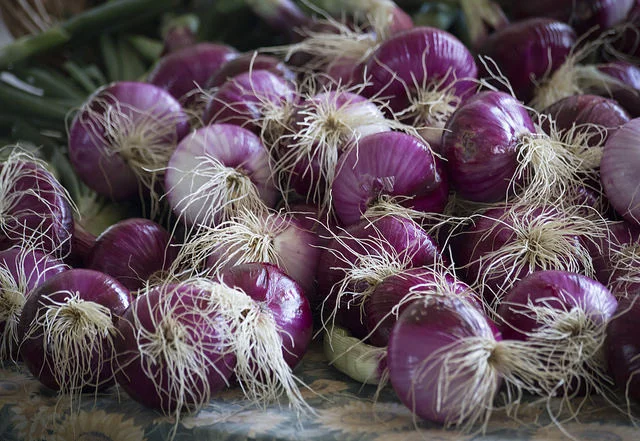
The onion is the bulb of Allium cepa, a herbaceous plant closely related to garlic, leeks, shallots, and chives.
Belonging to the same family as the onion are pearl onions, spring onions, and shallots.
Originally, the onion was classified within the Liliaceae family, but recent taxonomy places Allium cepa in the Amaryllidaceae family.
The onion is wonderfully versatile in the kitchen; it can be used both as a flavour enhancer and as a satisfying ingredient in its own right.
Available year-round, onions possess their fullest flavour when harvested during the warmer months.
They can be enjoyed cooked or raw, and come in several delightful varieties:
White
With a pronounced taste, perfect for creating the base of many dishes.
Yellow
Mild in flavour, ideal for roasting or baking.
Red
Sweet and delicious, often eaten raw or used to lend depth to sauces.
Characteristics
The onion is one of the most ancient and widely cherished vegetables.
It is a biennial herbaceous plant marked by fibrous roots, cylindrical leaves, and bulbs of varying shapes formed by the thickening of several leaves.
Diving deeper, an onion’s leaves comprise two parts:
- the sheath, a tubular base section;
- the blade, a fleshy, wax-coated part.
The edible bulb—the plump and tasty portion—is made up of the inner sheaths transformed into cataphylls.
These are scale-like, chlorophyll-free leaves called tunics layered tightly together.
The outermost leaves remain thin, appearing like papery plates in shades of orange or purple, acting as a protective barrier for the interior. The bulb also contains one or more buds inside.
A defining feature of fresh onions is their robust and aromatic flavour.
Uses, Culinary Applications and Typical Sicilian Varieties
Onions are wonderfully adaptable in cooking, used predominantly as an aromatic base.
Their distinctive flavour enhances dishes considerably, yet they can just as well be savoured on their own or as part of a soffritto.
Though some may shun them, even the shoots from older onions are edible and, owing to their sharp taste, can be used as a chive substitute or as a garnish.
Beyond the kitchen, onions are valued for their health-promoting properties and find uses in pharmaceuticals and the cosmetic industry.
There are numerous onion varieties, classified by factors such as:
- the shape of the bulb;
- the colour of the tunics — white, red, or yellow;
- flavour, with red onions generally being more aromatic;
- harvest season — autumn/winter or spring;
- usage — fresh eating, pickling, drying for ready-made foods, or industrial purposes.
The quintessential Sicilian varieties include:
Giarratana Onion
Grown around Giarratana and the Iblei plateau, it is celebrated for its sweet, never sharp flavour and impressive size.
The bulbs are flattened in shape, with a pale brownish-white tunic, weighing up to 300 grams.
Red Onion of Partanna
Cultivated across Castelvetrano, Campobello di Mazara, Partanna, Salaparuta, Santa Ninfa, and Poggioreale, this onion is known for its sweet flavour and generous size.
Its broad leaves carry a reddish hue, while its aroma strikes a balance between gentle and full-bodied, delivering a sweet taste.
The onion holds a cherished role in Sicilian cooking, not only as a flavour enhancer but also as the star in dishes such as the classic cipollata.
Nutritional Benefits of Onions
Onions are a treasure trove of nutrients beneficial to our health.
Despite being low in fibre, they contain a pleasing amount of fructose, lending them a sweet, substantial character, along with modest levels of minerals and vitamins.
The true richness lies in their sulphur compounds: allyl propyl disulphide, flavonoids, enzymes, and glucokinin.
Tips for Choosing
When buying onions, look for ones that feel firm, without bruises, mould, or sprouting.
Storing Your Onions
Store onions in a cool, dry, shaded spot at room temperature, where they can keep for around two to three weeks.
Check regularly for any signs of sprouting.
After harvesting and prior to storage, it’s best to leave them out in the sun for about a week to dry the green tops thoroughly.