The Menfi prickly artichoke stands as a gastronomic jewel of Sicily, currently under threat from fierce competition, and one we’re all called upon to protect and celebrate.
For many, winter can feel like a barren season, where trees stand bare and fruits lie past their prime.
Yet, especially in Sicily, the colder months gift us with earth’s treasures that bring warmth to our tables on chilly days—not freezing, but certainly not warm either.
So, as melons, prickly pears, and peaches gracefully exit the scene, our plates begin to welcome vibrant citrus fruits, pomegranates, and the ever-versatile artichoke.
Italy proudly leads the world in cultivating this quintessentially winter vegetable, boasting diverse varieties across its landscape.
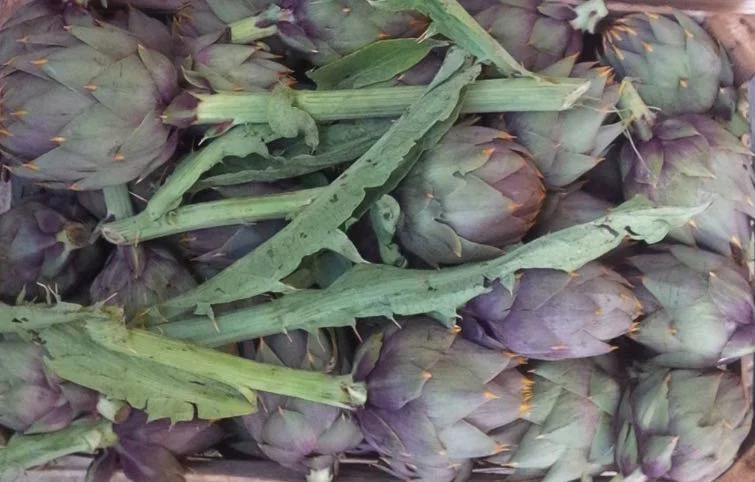
Among these, the Menfi prickly artichoke holds a revered place. Its name, derived from the tiny spines crowning its edible bracts, hints at its distinctive character—its green hues mingled deeply with rich violet tones.
These very spines, which earn it the affectionate nickname spinello, also present a challenge, putting it at a disadvantage compared to spineless hybrid varieties.
The Menfi prickly artichoke offers a uniquely aromatic flavour that shines especially when grilled over an open flame, but it also stars in many treasured Sicilian dishes.
A Flower You Can Eat
The Menfi prickly artichoke is one among many artichoke varieties, scientifically known as Cynara cardunculus scolymus.
The genus name refers to a group of flowering plants within the broad Asteraceae family.
This family includes familiar plants like lettuce, radicchio, chamomile, and wormwood.
The species name cardunculus literally means “resembling a little thistle.”
Thus, cardunculus scolymus is in essence the tamed descendant of the wild thistle—a sort of botanical forebear to the artichoke we know today.
The artichoke itself is an herbaceous plant with a non-woody stem that can reach up to one and a half metres tall.
Its leaves vividly demonstrate polymorphism—they present different forms on the same plant. Some bear deeply divided leaflets, while those closer to the flowers are whole.
These flowers, known as capitula and typical of the Asteraceae family, are shielded by secondary bracts.
It’s these bracts, alongside the base called the receptacle, that we enjoy eating.
In fact, the artichoke isn’t a fruit but an edible flower bud of the cardunculus scolymus.
The Wild Thistle’s Journey
To tell the story of the artichoke—and of the Menfi prickly artichoke—we must first mention the wild thistle, its wild ancestor.
This plant is believed to have originated in the Middle East, with evidence suggesting use even as far afield as India.
There’s a third-century BC fresco discovered in a cave, portraying a monk holding the wild thistle.
Both the Egyptians and Greeks valued this plant for its spiritual and medicinal properties. In Greek mythology, its origins are tied to a nymph named Cynara.
Cynara, with ash-blonde hair and striking green eyes flecked with violet (ringing any bells?), was desired by Zeus, yet her proud and mercurial nature led her to reject him repeatedly.
Enraged by this scorn, Zeus transformed her into a spiny, rigid plant that concealed a tender heart suffused with violet hues.
A Sicilian Touch Transforms the Wild Cardoon
Wild thistle made its way into Italy, likely brought by the Etruscans, and rapidly gained favour—not least for its reputed aphrodisiac qualities.
It appears that in Sicily, around the first century BC, the domestication of the wild thistle took place, giving rise to the artichoke we recognise today. Even now, in Mazzarino, cultivation persists of a venerable artichoke variety still closely linked to the wild thistle.
Sicily’s fields soon burgeoned with artichoke crops, impressing successive rulers, including the Arabs, who called the plant ḵuršūf.
The Arabs introduced the artichoke to Spain, after which the Dutch helped spread it to English monarchs, who cultivated it in their royal gardens.
This Sicilian specialty made its way to Tuscany, cherished by Catherine de’ Medici, who then brought it to the French court of her husband, Henry II. Centuries later, even Louis XIV was known to delight in artichokes.
As explorers travelled across oceans, the plant reached the Americas, where sprawling artichoke fields now thrive in Louisiana and California—though in some places it has become an unwelcome invasive species.
The Menfi Prickly Artichoke Today
Italy leads the globe in cultivating this winter vegetable, with several varieties including the renowned Menfi type.
Menfi is a small coastal town in the province of Agrigento, close to the border with Trapani, nestled between the Belice and Carboj rivers and near the Trinità and Arancio artificial lakes.
This area benefits from excellent irrigation systems, fertile dark soils, and a warm yet moderated climate thanks to gentle sea breezes—ideal conditions for diverse farming, with the Menfi prickly artichoke as its shining star.
Records mention this variety dating back to the 1800s, though its cultivation in the strip between Belice and Carboj likely goes back centuries, perhaps millennia.
Today, alongside the prickly heirloom, spineless hybrid artichokes are also grown in Menfi.
Farmers face a tough choice, as the market favours easier-to-handle spineless hybrids, which also yield more abundantly.
Harvesting the Menfi Prickly Artichoke
Nevertheless, local landowners cherish their distinctive cultivar, continuing its cultivation despite stiff competition, joining together in a protective alliance that safeguards the heritage not just of Menfi’s artichoke but also those from the entire Belice and Carboj basin.
The diligent work starts in September, when the tiny artichoke buds are sown in fields dedicated solely to their growth.
For two months, the plants require little more than gentle watering, without need for fertilisers or pesticides, before the harvesting begins and carries on until late April.
By 1st May, farmers gather to enjoy the season’s final artichokes, grilled over hot coals. Afterwards, all remaining plants are cut back to encourage the release of new buds, which are planted in September once again.
This cycle repeats for two years before fields are rotated to cultivate broad beans, which help replenish nitrogen in the soil ahead of the next artichoke cycle.
How to Enjoy the Menfi Prickly Artichoke
The final crop produces smaller artichokes than hybrids, shaped elliptical when they first flower (known locally as “mammi”) and becoming more ovoid in later stages (“spaḍḍi”).
Their bracts, crowned with those singular spines, display a captivating blend of green and violet—a true signature of the Menfi variety.
The best way to savour the Menfi prickly artichoke is over glowing embers. Before grilling, give the artichokes a sharp tap against marble slabs, spine-side down, to coax open the bracts. Once charred, drizzle with good olive oil and a pinch of sea salt.
This simple ritual perfectly enhances the artichoke’s aromatic notes and brings out the delightful crunch of its leaves.
This remarkable variety also lends itself beautifully to classic Sicilian recipes, such as fritti (battered artichokes), artichokes in rich tomato sauce, or the beloved pasta con i carciofi di Menfi.
A Few Fun Facts
Low in calories yet packed with iron and minerals, artichokes are superb for a balanced, healthy diet.
Over the centuries, artichokes have been valued medicinally, too—with cynarotherapy emerging as a promising treatment method.
Their name traces back to the nymph Cynara; it’s also the root of the famous bitter Italian liqueur Cynar, flavoured with artichoke.
In America, artichokes have become central to agriculture in Castroville, California, which hosts an annual Artichoke Festival. The festival even crowns a Miss Artichoke—none other than the iconic Marilyn Monroe was the very first to earn the title.
Wondering how best to eat an artichoke? A Neapolitan saying offers wisdom: “A carcioffola se monna a ‘na foglia a vota”—reminding us that everything should be savoured one leaf at a time, gently and patiently.