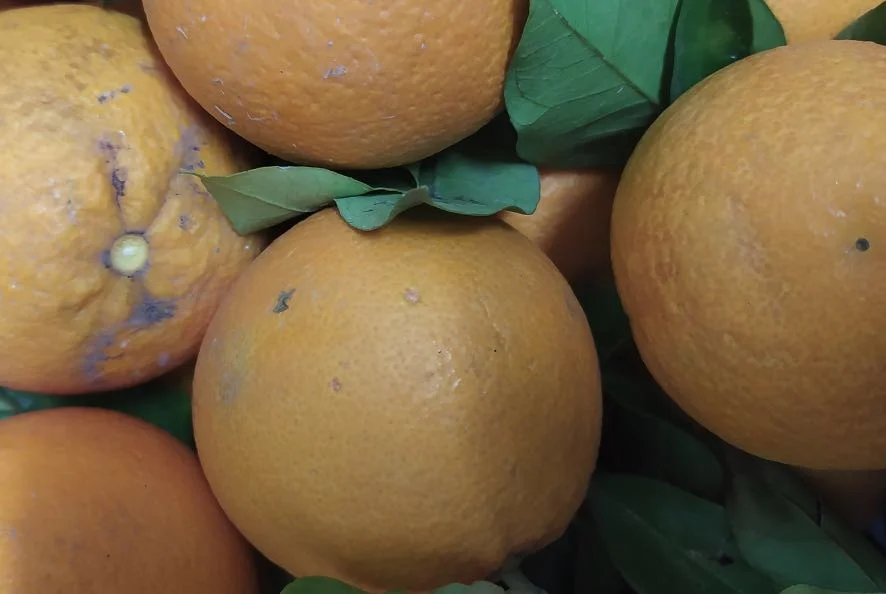
The “biondo di Scillato” orange is a celebrated culinary jewel hailing from the Madonie region.
As the character “uncle” remarked in Johnny Stecchino, one of Sicily’s enduring trials is indeed its relentless drought.
With its scant rivers and limited rainfall, our island is often thirsty, meaning every brook and underground spring must be carefully harnessed.
This is precisely what happened in Scillato, a small town nestling on the western slopes of the Madonie. Here, springs cascade down from the surrounding mountains, and for nearly a thousand years, several watermills have dotted the landscape, vital not only for grain but for tending the region’s diverse crops.
Alongside apricots, Scillato proudly boasts another entry on Sicily’s list of Traditional Agri-food Products: the “biondo” orange.
The orange tree
The term “biondo” refers to the distinctive golden colour of this particular Citrus sinensis fruit.
Orange trees belong to the Rutaceae family—what we commonly know as citrus—and can soar up to 12 metres tall.
From winter through to mid-spring, ripe fruits hang entwined amongst fragrant clusters of citrus blossoms, the iconic white zagare, perfuming the air.
Oranges come in many varieties, but chiefly one can distinguish them by colour: the red-fleshed types and the blondes, like those from Ribera or Scillato.
A brief history of the orange
The Citrus sinensis originated as a cross between a pomelo and a mandarin over 4,000 years ago in what is now the borderlands of China and Southeast Asia (think Thailand and Vietnam).
This citrus made its way along the Silk Road to the Middle East and eventually Italy, brought to us by the Romans.
Ancient texts mention Sicilian groves of “melarance,” though for centuries these orchards lapsed into obscurity. It was Portuguese sailors in the 15th century who reintroduced the fruit, giving rise to its Italian name portogallo, which endures today in the Sicilian dialect as partuallu.
For a richer tale of this fruit’s journey, we suggest exploring the article dedicated to the Ribera DOP orange.
The birth of the Brazilian orange
Italy boasts at least 40 sub-varieties of oranges, with Sicily serving as a truly remarkable orchard. Beyond the famed Ribera DOP and the Arancia Rossa di Sicilia IGP, the island is fertile ground for citrus.
This vibrant fruit also crossed the Atlantic, giving rise to a unique variety in Brazil known as the Navel orange.
This fascinating mutation first appeared in 1820 at a Brazilian monastery overlooking the Atlantic. In the following years, this distinctive orange journeyed back to Europe and Sicily, where it’s affectionately called the “brasiliana.”
A double fruit
This name, tying it to its Brazilian roots, refers to a special type of orange known as the “navel.”
In English, navel means belly button, alluding to the pale dimple you’ll find opposite the stem end on a Brazilian orange.
That “belly button” is, in fact, the outer surface of a second, smaller fruit nestled within the larger one. You heard right: inside a navel orange grows a tiny twin, visible when you inspect the side opposite the stalk.
Within this charming navel family are varieties like Navelina, Washington Navel, and the Brasiliano, but in Sicily, “brasiliana” tends to be the common term for any navel orange.
Xillatum (Scillato) and its golden orange
This naming custom also applies to the “biondo” orange from Scillato, a tiny town in Palermo province, perched at the foothills of the Madonie and just a stone’s throw from Cefalù.
Countless millennia ago, this land was inhabited, legend says, by Trojan refugees seeking shelter, attracted by the plentiful springs still flowing from the three mountains looming above: Cozzo di Castellazzo, Monte dei Cervi and Monte Fanusi.
Over the centuries, numerous mills were established, the earliest recorded in 1156 identifying the locale as Xillatum—from which modern Scillato takes its name.
The late harvest of the “biondo di Scillato” orange
Thanks to its abundant springs and the blessing of hilltop breezes, the Madonie region has always been ideal for citrus cultivation.
This serendipity gives the Scillato orange a crucial advantage: it can ripen as late as April, far beyond many other varieties.
Harvesting commences in March, following months of careful irrigation, and each orange is handpicked with pride and precision.
Characteristics of the “biondo di Scillato” orange
The “biondo di Scillato”, also known as brasiliana, includes three varieties: Washington, Nareline and Navelate.
This fruit wears a pale orange skin, quite distinct from the deep red of blood oranges, which owe their colour to anthocyanins.
Inside, the flesh is similarly light and dotted with seeds, offering a pleasantly sweet flavour that often surprises those accustomed to sharper citrus.
Perfect for juicing due to its generous yield, it’s equally delightful eaten fresh. In the kitchen, it’s used to flavour the Sicilian sarda a beccafico, while the peel is transformed into candied treats, starring in beloved desserts like cannoli and cassata.
Every April, Scillato comes alive with a festival honouring the “biondo di Scillato” orange, a lively prelude to the celebration of the Scillato apricot. Both are cherished entries on Sicily’s P.A.T. register (Traditional Agri-food Products).
A touch of folklore
According to Greek mythology, Hera presented Zeus with oranges, carefully guarded by the Hesperides nymphs.
Historically, diners would often sip capillaire after meals—a coffee enriched with orange peel.
Several proverbs revolve around the orange too:
“An orange in the morning is gold, at lunch it’s silver, in the evening it’s lead.”
“Sweetness at home is like oranges: you must nurture it with great care.” (Pino Caruso)
Aranci, aranci, cu havi vai si li chianci! (“Oranges, oranges — those burdened with troubles must bear them.”)