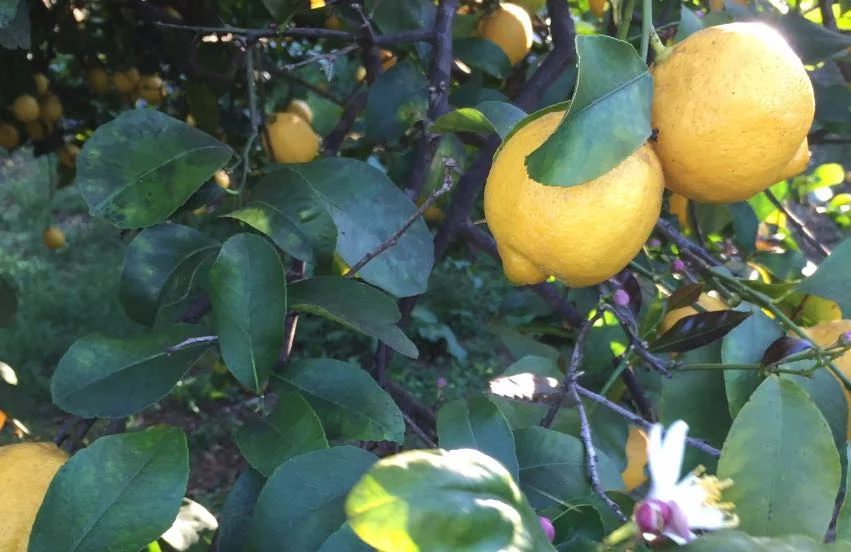
The Siracusa Lemon PDO traces its origins back to the distant lands of South-East Asia.
From Burma, this remarkable fruit made its way to Sicily, where the island’s unique climate proved even more favourable for the lemon tree’s flourishing growth than its native home.
Interestingly, it wasn’t the local farmers who first recognised its potential, but the Jesuit fathers, who championed this variety to give a significant boost to the island’s economy.
The lemon is the fruit most closely linked with Sicily, its bright yellow hue lighting up the landscape.
The Siracusa lemon, also known as the femminello siracusano, takes its name from the femminello variety to which it belongs.
It is distinguished by a skin that ranges from green to a vivid yellow, packed with juicy pulp and a high concentration of essential oils. These qualities make it one of Italy’s most iconic lemons and have earned the femminello siracusano its PDO status.
The Lemon Tree
Our luscious golden lemon comes from the Citrus limon, a tree belonging to the Rutaceae family, commonly known as citrus fruits.
Experts believe it is a natural hybrid between the citron and the bitter orange. The tree can grow up to six metres tall and blooms twice a year with delicate white flowers called zagare.
These blossoms give way to lemons, which on the same tree can have either green or yellow skins. Inside, the fruit is divided into segments, each containing tiny juice-filled sacs known as lemmy.
Like all citrus, the Citrus limon hails from the Far East.
The Far East
Records show lemons were cultivated in China before the Song dynasty, which began around the end of the first millennium.
However, the true birthplace of the Citrus limon is likely a broad region stretching from Burma to Assam in India, near the Bay of Bengal.
Thanks to ancient texts, we know the Greeks and Romans were familiar with this citrus, which also appears in some wall paintings.
Known as the apple of Media (modern-day Iran), it was used in ancient Rome more as a remedy than a food, due to its sharp, intense flavour.
It’s probable that lemons reached Rome via soldiers or traders, as there’s no archaeological evidence of lemon cultivation in Europe at that time.
From the Holy Land to Italy
By the 8th century, the Citrus limon had spread to the Middle East, between Egypt and Persia. It was in present-day Iran that the lemon acquired its name, derived from the Persian word līmū, which referred broadly to all citrus fruits.
With the rise of the caliphates, the Arabs rediscovered the lemon, valuing not only its flavour but also its medicinal properties, leading to its widespread cultivation across the region.
When the Crusaders returned from the Holy Land, they brought lemon saplings with them, particularly to the port of Amalfi, from where the fruit spread throughout Italy and later to the Americas aboard the famous Three Ships.
Lemons in Sicily: Siracusa and Interdonato
The lemon also found its way to Sicily, forging an unbreakable bond with the island, even if the locals were not immediately aware of its potential.
The Citrus limon thrives best between the 40th parallels north and south, a belt that includes South Africa, Mexico, Uruguay, and the Mediterranean basin.
Sicily’s location, combined with its unique hilly terrain and climate, makes it the perfect home for the lemon.
Yet, for a long time, the tree was merely ornamental until the 17th century, when the Jesuit fathers applied their botanical expertise to improve lemon cultivation.
This led to a significant increase in production and the establishment of dedicated citrus farms, exporting as far as English ports.
The Siracusa Lemon PDO
The key to the Siracusa lemon’s success lies in its proximity to the sea.
Lemons bearing the PDO label are grown within a narrow 10-kilometre coastal strip along the Ionian Sea, stretching from Augusta to Noto and including towns such as Avola, Floridia, Rosolini, and Siracusa itself.
Moreover, the orchards are situated no higher than 210 metres above sea level, with the compact soil cooled by streams like the Marcellino, Anapo, and Asinaro, which flow down from the nearby Hyblaean Mountains, framing the coastal Val di Noto area.
A Year-Round Bloom
Here, vast groves of femminello lemons flourish, named for their remarkable fertility. The trees flower and bear fruit throughout the year, and depending on when they ripen, the Siracusa Lemon PDO is classified into three types:
- Bianchetto, harvested from mid-April, with yellow skin and pulp
- Verdello, with green skin (as the name suggests) but yellow flesh, ripening from July
- Primofiore, appearing on the tree from October, with skin ranging from yellow to pale green.
In all cases, the lemons are hand-picked using scissors to preserve their quality.
Uses of the Siracusa Lemon PDO
All three varieties burst with juice and citric acid, but it’s the essential oils in the femminello siracusano that have made it a prized ingredient in cosmetics and perfumery worldwide.
The peel and pulp are perfect for crafting limoncello, ice creams, candied fruits, desserts, and a host of delicious recipes.
In 2000, the Siracusa lemon was awarded PDO status, recognising its vital role in Italian lemon production, accounting for a third of the national harvest.
It also takes centre stage during the feast of Saint Lucy, Siracusa’s patron saint, when her statue is paraded through the streets on 13 December, adorned with lemons and oranges.
Did You Know?
In days gone by, lemon was rubbed on teeth to keep enamel strong; even today, it’s used in medicine, for instance, to help lower blood pressure.
The ancient Egyptians used lemons in embalming their pharaohs, while the Greeks employed them as a natural moth repellent.
During the age of exploration, lemons were an essential remedy against scurvy, a disease caused by vitamin C deficiency among sailors.
The lemon also features in some traditional sayings:
“Take what you can from the orange, but make the most of the lemon.”
“Two beans, oil and lemon, and you’ll feel as strong as a lion.”