When it comes to Sicilian produce, the orange is undoubtedly the fruit most closely linked to the island. Its familiar sunlit orange shade is almost synonymous with Sicily itself.
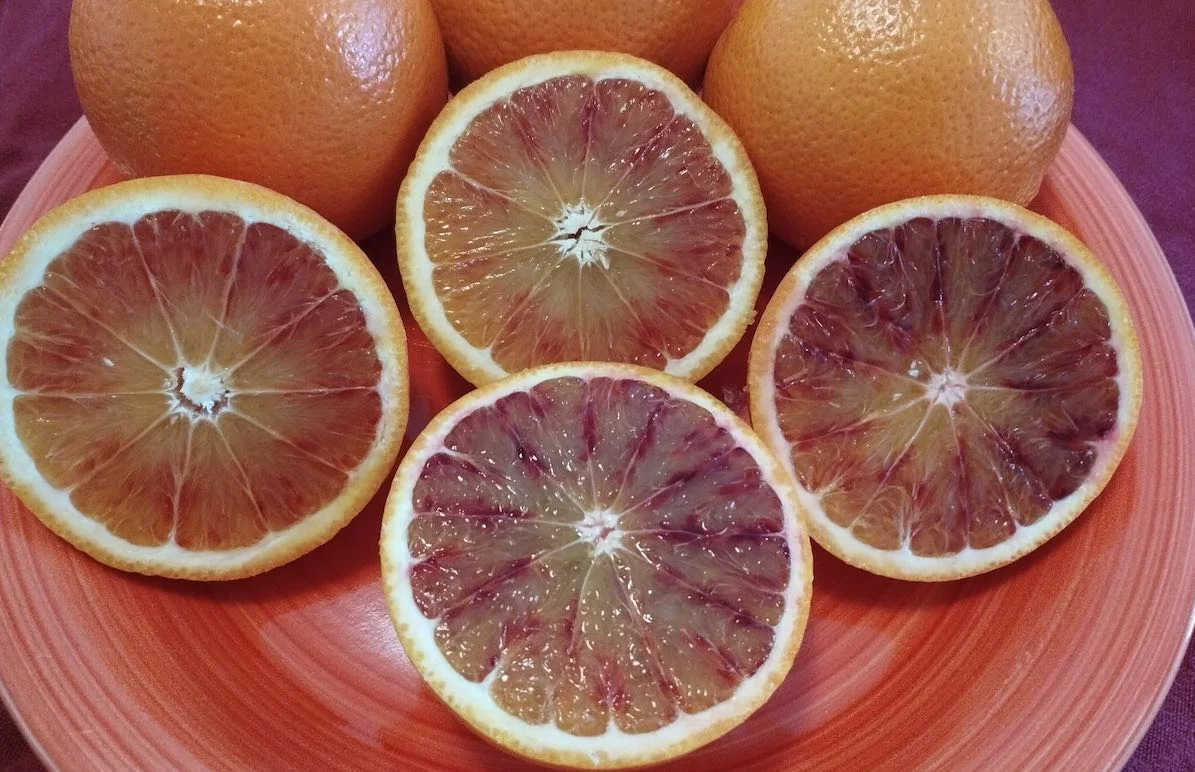
Yet, not all oranges wear the same colour: in the eastern provinces of Enna, Catania, and Syracuse, the unique Red Orange of Sicily flourishes.
Its distinctive crimson pigmentation and exquisite flavour have earned this particular variety the IGP (Protected Geographical Indication) status.
The Sweet Orange
Even when we speak of the red orange, we are dealing with the Citrus Sinensis, a member of the Rutaceae family, commonly known as the sweet orange.
This tree should not be confused with varieties that produce bitter fruit.
Citrus Sinensis itself is an ancient hybrid, born from a cross between the pomelo and the mandarin, a union dating back some 4,000 years.
The resulting tree is tall and luxuriant, with long, fleshy leaves and juicy fruits.
From China to Europe
Thanks to its tart yet sweet taste, the orange quickly spread across East Asia, particularly China. From there, it travelled along the Silk Road, eventually reaching Europe and, ultimately, Sicily.
The exact timing and pathway are a matter of debate.
One theory suggests Portuguese sailors brought the orange to Europe in the 15th century, which is why, until recently, the fruit was known in Sicily as "portogallo" (or pattuallu in the local dialect).
Another view posits that the orange was introduced as far back as Ancient Rome, supported by documentation and the presence of a centuries-old orange tree in a Roman monastery dating to the 13th century.
This intriguing backstory is explored in detail in our feature on the Ribera Orange DOP. Regardless, the orange swiftly became a staple across Europe and later throughout the Americas.
From Groves to Dinner Tables
Today, Brazil leads the world in orange exports, with China and India following closely behind.
The fruit’s unmistakable flavour has brought it widespread acclaim, particularly the familiar blonde orange with its bright pulp — such as Sicily’s famed Ribera Orange DOP.
The red orange, however, has had a different journey. Also originating from China and introduced to Europe by the Arabs, who prized its qualities, its unusual appearance meant it was long confined to ornamental use.
It finally made its way to Sicilian palates thanks to a Genoese missionary returning from the Philippines, who brought the red orange to the island.
The Red Orange of Sicily
Here, this uniquely pigmented citrus gained great popularity. By the mid-20th century, Sicily’s red orange earned recognition throughout Italy and beyond, leading to a significant expansion in its cultivation and trade. Today, it forms an important part of the local economy.
Its success is partly down to the alluring red blush — the result of anthocyanins — which vary in intensity across the different varieties.
Despite its name, the production area covered by the IGP, awarded in 1997, is limited to a specific zone mostly between the provinces of Catania and Syracuse, also encompassing parts of Enna, including the towns of Catenanuova, Centuripe and Regalbuto.
The Varieties of Sicily’s Red Orange
Within this region, nestled between the Iblean interior and the Ionian Sea, these special oranges find ideal conditions. The harvest runs from December through to May, thanks to three main varieties maturing at different times:
- Tarocco, ripening from December to May: the most recognised and widely grown variety. Large in size, it features a distinctive "nose" or pronounced base. The skin is orange with red speckles, while the juicy flesh — seedless — is amber with crimson streaks that vary in intensity depending on the clone.
- Sanguinello, from February to April: its name reflects its vivid red rind. This medium-sized variety contains a few occasional seeds. The flesh remains amber but is noticeably more tinged red compared to Tarocco.
- Moro, from December to March: a medium-sized fruit with an orange skin imbued with deep wine-red hues. This striking red carries through to the pulp, entirely crimson due to a high anthocyanin count, which also lends it a brighter acidity than the other varieties.
Harvesting and Marketing the Red Orange of Sicily
The harvest practices are similar across the three varieties but staggered according to maturity.
Pickers use curved scissors to snip the stalk carefully, avoiding damage to the skin that would compromise the fruit’s quality.
Once harvested, the red oranges are brought to Italian markets untouched by chemical treatments.
Their natural juiciness makes them ideal for eating fresh or pressing into invigorating juices, prized not only for their anthocyanin content but also for their antioxidant qualities.
The peel often finds its way into traditional Sicilian candied fruit, essential for classics like cassata and cannoli, while the pulp is perfect for homemade marmalades.
A Few Fun Facts
Oranges are well known for their vitamin C and health benefits. Notably, the red orange boasts 40% more vitamin C than its blonde cousins.
Legend has it that the orange was Hera’s dowry to Zeus, who guarded these precious fruits in a garden watched over by the nymphs known as the Hesperides.
The orange has inspired many sayings and proverbs:
"In Sicily, oranges are sweets that grow on trees" (Pino Caruso)
"An orange in the morning is gold, at lunchtime silver, and in the evening lead."
"Take what you can of the orange, and as much as you can of the lemon."
And finally: aranci, aranci, cu havi vai si li chianci! ((“Oranges, oranges — those burdened with troubles must bear them.”))