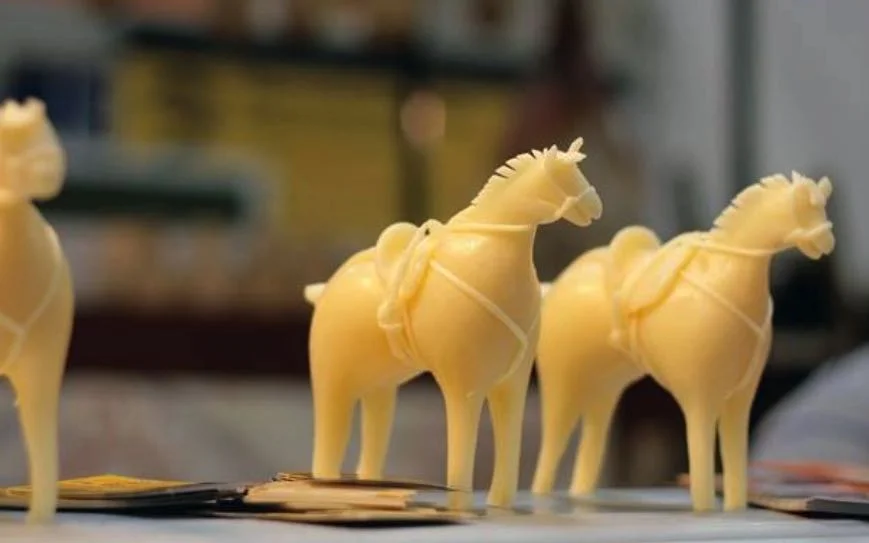
Sicilian caci figurati are an unparalleled specialty in Sicily’s cheese repertoire, deserving recognition among the island’s finest gastronomic treasures.
We often explore Sicilian recipes and culinary delights distinguished by unique, time-honoured methods passed down through generations.
Yet few influence the very appearance of the food itself quite like these caci figurati, save perhaps the Cammarata and San Giovanni Gemini Ainuzzi cheeses, which we’ve previously explored in depth.
Resembling the distinctive Cammaratese cheese, the caci figurati siciliani hail mainly from nearby Contessa Entellina, nestled between the Monti Sicani near Monte Cammarata and the Belice Valley. Their production also extends into the Nebrodi hills.
Like Ainuzzi, they belong to the stretched-curd family of cheeses, immediately recognisable by their exquisite craftsmanship in the form of stags, horses, fallow deer, and hens.
Made from cow’s milk, they boast a pale straw-yellow rind and a sweet, supple interior.
How the Cheese is Crafted
The caci figurati siciliani are fashioned from cow’s milk, which is the primary distinction among the vast world of cheeses — though these can also be categorised by ageing, production techniques, rind presence, and so forth.
Depending on the milk source, cheeses are described as bovine, buffalo, pecorino (sheep’s milk), caprino (goat’s milk), or blends.
The production process itself is fairly straightforward: milk is poured into a vat and gently warmed to around 35 °C before starter cultures — either natural or introduced — are added. Next comes the rennet, a mix of enzymes usually extracted from the stomach linings of various animals, initiating the coagulation of milk fats.
This process yields the curd, the essential base of cheese, which may be roughly or finely cut and then matured according to the style desired.
A Journey Back to Mesopotamia
The word “cheese” traces its roots back to Latin — Roman soldiers ate blocks of curd they called formaticum. The term referred to a single form of caseus, the broader dairy product, which later influenced words like the Spanish queso and Sicilian caciu.
Cheese-making didn’t begin in Italy but in ancient Mesopotamia, as evidenced by the Dairy Frieze from the third millennium BCE, depicting priests at work crafting cheese.
Indeed, the origins of curdling predate this by millennia, coinciding with sheep farming in Mesopotamia some 10,000 years ago.
Legend has it that someone found curdled milk inside a kid goat’s stomach — marking the very beginning of cheese as we know it.
The Italian Evolution
Cheese soon spread to the Middle East and Greece, taking on mythical significance in ancient Olympic lore.
In Italy, cheesemaking dates back at least 5,000 years, with Neolithic tools for curd production discovered near Cremona.
The Celts and Ligurians further refined curd-based products long ago, giving us age-old favourites like robiola and stracchino. Yet it was the Etruscans who advanced the craft, introducing natural coagulants such as fig sap.
The Romans pushed innovation further, experimenting beyond sheep’s milk to use various milks, as recorded by the writer Marcus Terentius Varro.
Produced originally by monks, cheese then graced the tables of noble families — a journey we delve into more deeply when discussing Ainuzzi cheese.
Over centuries, each region — sometimes even individual villages — developed their own distinctive recipes, shapes, and production methods.
The Story of Caci Figurati
This applies perfectly to cheeses like the Vastedda del Belice or the Ainuzzi of Cammarata.
The caci figurati siciliani are similar to Ainuzzi but, unlike their Agrigentine cousins, their significance isn’t tied to a particular celebration. They are, rather, exquisite gifts of unmistakable artistic merit, suited to many occasions.
These culinary masterpieces first appeared in 1982 at the Sicilian Ethnographic Exhibition, charming the eyes and palates of Palermo’s locals and visitors alike.
The caci figurati siciliani are also mentioned in Antonino Uccello’s 1980 historical book “Bovari, Pecorari e Curatuli,” which also discusses the renowned Provola cheese of the Nebrodi.
The Provola of the Nebrodi
A brief aside on this relative of the caci figurati is warranted. It differs primarily in shape.
Born amid the rugged slopes of the Nebrodi Mountains, provola carries a rich history dating back to the 1400s.
For centuries, cheesemakers in the province of Messina have followed the same time-honoured methods, employing cow’s milk combined with lamb or kid rennet.
The true hallmark of Nebrodi provola is its unique ageing process — rare for this type of cheese — yielding a tasty yet wonderfully soft interior.
Crafting the Caci Figurati
The technique behind Nebrodi provola spread beyond the mountains to the Belice Valley, reaching the Palermo commune of Contessa Entellina.
Here and in the Nebrodi, the process remains consistent for caci figurati siciliani: fresh cow's milk from two milkings is heated to 36 °C, then lamb or kid rennet is added.
This produces the curd, which is broken up using a wooden stick called a rotula. Once separated from the whey (the latter used to make ricotta), the curd is gently reheated and left to rest under cloth for at least a day.
But unlike provola, the stretched curd is then deftly shaped by an expert cheesemaker into various intricate figures — stags, fallow deer, horses, hens — before being salted in brine, dried, and set aside to mature further.
Characteristics of Sicilian Caci Figurati
The finished cheeses are as remarkable for their artistic beauty as for their taste, sporting a pale straw-yellow rind and a soft yet firm white interior.
These unique creations make for unforgettable gifts, prized not only for their craftsmanship but also for the sweet, delicate curd that almost melts on the tongue.
A product rooted in an ancient tradition lovingly tended by Nebrodi cheesemakers over centuries, it now enjoys protected status as a Traditional Agri-food Product (Prodotti Agroalimentari Tradizionali, P.A.T.).
A Few Fascinating Tidbits
In Ancient Greece, cheese was highly valued by Olympic athletes, linked to the mythical figure Aristaeus — son of Apollo and nymph Cyrene — credited with teaching humankind the art of animal husbandry.
The Medicis showcased cheese at their lavish banquets, as did the Este family, who offered generous portions of Parmesan to their guests.
In Liguria, the robiola holds a proud, ancient heritage; its name nods to the reddish hue of its rind, derived from Latin rubeola. In Sardinia, the callu de cabrettu is traditionally produced within a kid goat’s stomach.
Cheese also finds its place in proverbs:
“Fresh bread, old wine, young wife and aged cheese.”
“Cheese is wholesome food, if eaten sparingly and slowly.”
“The mouth isn’t tired unless it tastes of cheese.”