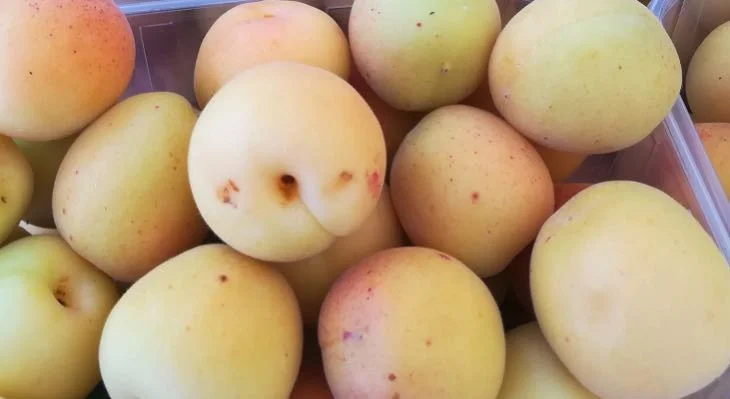
The Scillato apricot undoubtedly ranks among Sicily’s culinary treasures.
Since the dawn of agriculture, we humans have battled countless challenges to nurture our crops—not only the obvious threats like floods or droughts but also the less conspicuous yet formidable foes: insects.
In the Mediterranean environment, one notorious culprit is the so-called “fruit fly,” a scourge for growers throughout our beloved Mare Nostrum.
Yet, the Scillato apricot skilfully evades this menace by ripening early, thus staying a step ahead of the marauding insect.
Thanks to its almost complete freedom from pesticides, this fruit boasts remarkable purity, with tender, sweet flesh that shines in many traditional Palermo recipes—and beyond.
The Apricot Tree
The variety grown in Scillato is a hardy strain of apricot, the fruit of the Prunus armeniaca.
This tree belongs to the Rosaceae family—which includes roses as well as perry pears, almonds, and apples—and is characterised by broad, ‘latiform’ leaves. Its blossoms, a delicate white tinged with pink veins, appear before the leaves, as is typical for Prunus species like almonds, peaches, and plums.
Following flowering, apricots develop as drupe fruits, containing a woody pit at their core.
Italy ranks as the world’s sixth largest apricot producer, behind powerhouses such as Turkey and Uzbekistan.
The Armenian Apple
This fruit’s homeland lies further east, in the Caucasus and steppes, regions with long-standing cultivation traditions.
For many centuries, Italians believed apricots originated in Armenia and the surrounding Caucasus area.
Thus, the ancient Romans dubbed the apricot the “Armenian apple,” mistakenly linking it to that part of the world.
Legend has it that Alexander the Great encountered the apricot during his campaigns and, captivated by its sweetness, introduced it to his homeland.
It subsequently made its way to Italy, brought back by the Roman consul Lucullus, earning the enduring moniker “Armenian apple.”
The Arab Contribution
While the Romans were the earliest known cultivators, the apricot faded into obscurity during the Middle Ages.
Its cultivation was revived thanks to the Arabs, who also refined the techniques for growing it.
The apricot was once known as “praecoquum,” meaning “early” or “early-ripening.”
However, the Arabs misunderstood the term, which evolved into al-barqūq, the root of the word we recognise today—found across many languages.
Looking Even Further East
Interestingly, some Italian dialects retain traces of the apricot’s Armenian association—in the northeast, it’s known as armelin, and in Lombardy as mugnagh, both echoing the Roman “Armenian apple.”
Even in the 18th century, the Swedish botanist Linnaeus believed in Armenian origins and named the species armeniaca.
In truth, the apricot’s roots trace deeper east, to Persia or even India.
From there, it travelled via caravan routes to Armenia, before Alexander the Great carried it into Europe.
Scillato and Its Apricots
The apricot isn’t an ancient cultivar in Scillato; its cultivation began only in the 1970s.
Nevertheless, it quickly flourished, thanks in part to Scillato’s location and rich history.
This history goes far beyond its recent transformation from a district of Collesano to an independent community, stretching back to tales of Trojan refugees finding refuge in the Madonie hills.
These uplands are nourished by abundant streams flowing from peaks like Cozzo di Castellazzo, Monte Fanusi, and Monte dei Cervi.
To harness these waters, mills were built—one documented as early as 1156 in the area then called Xillatum, from which the village’s name is derived.
The Threats Facing Scillato’s Apricot
Though a small village with fewer than 700 residents, Scillato prides itself on two celebrated local specialities recognised by the Italian Ministry of Agriculture: the “biondo” orange and, notably, the apricot.
The magic of the Scillato apricot lies in its early ripening period, spanning from March through early summer.
This timing allows it to avoid the attacks of Ceratitis capitata, the Mediterranean fruit fly.
This dreaded insect, likely native to sub-Saharan Africa but now found worldwide, ravages not only apricot orchards but a variety of fruit trees—favouring those with tender, sweet flesh that make easy targets for the female fly to lay her larvae, which wreak havoc as they hatch inside the fruit.
Like many Mediterranean regions, Sicily struggles with infestations, especially from June onwards.
Characteristics of the Scillato Apricot
Thanks to its early maturation, the Scillato apricot escapes the fate that befalls many fruits.
By ripening from March into June, it sidesteps the key egg-laying period of the fruit fly, producing pristine fruit without needing pesticides.
Beyond annual pruning, farmers undertake no interventions until they harvest by hand.
These apricots boast a yellow-orange skin, subtly freckled with red hues, which the luscious, soft flesh mirrors. Exceptionally sweet and delicate, they are perfect enjoyed fresh, feature in many Palermo-era dishes, and make exquisite jams.
Come June, Scillato celebrates this cherished fruit with a festival, championed by a group of local youths known as the Carusi.
Did You Know?
Apricots can be savoured fresh, dried, preserved in syrup, or as jam—the last famously featured in the iconic Sachertorte.
In China, the apricot’s true birthplace, women traditionally ate them to boost fertility—a claim science now supports, recognising the fruit’s role in female hormone production.
Arab physicians once prescribed apricots to soothe ear ailments, while a quaint English tradition held that dreaming of apricots was a sign of forthcoming good fortune.
The apricot also inspired a beautiful poem by Ada Negri:
This morning blossomed the young apricot
alone and first in the still-bare garden.
On its three tallest branches
it bloomed lightly: in its winged whiteness
it laughed at the blue with childhood wonder.