
Overview
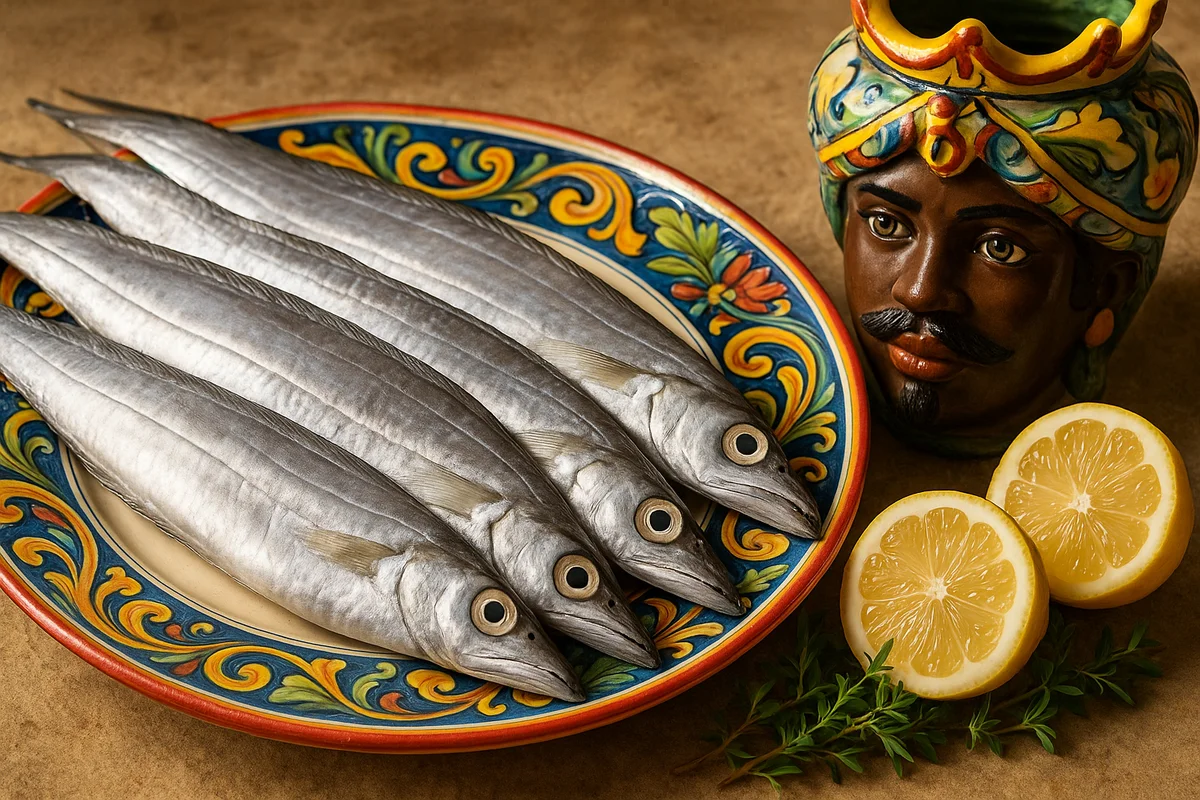
The scabbardfish is a marine species belonging to the Lepidopodidae family, distinguished by its elongated, laterally compressed body shaped like a blade or spatula (hence its name). It inhabits the deep waters of the Mediterranean and is fished in Sicilian seas, where it is appreciated for its white, firm and delicate flesh with a fine, subtle flavour. It is considered a prized fish, less common than other species but sought after by connoisseurs for its excellent quality.
In Sicilian culinary tradition, scabbardfish is treated with great respect, prepared simply so as not to overshadow its delicate taste: grilled, baked, fried, or cooked in a pan with Mediterranean herbs. It demands absolute freshness and quick cooking that preserves its tenderness. It is found at Sicilian fish markets particularly along the coast, sold whole or in steaks. Its distinctive appearance, with a bright silvery body and unmistakable shape, makes it easy to recognise. It is a symbol of the rich marine life of the Sicilian Mediterranean and of the skill of local fishermen.
Characteristics
The scabbardfish has a very elongated, laterally compressed body, similar to a ribbon or blade, reaching 1.5–2 metres in length, although common specimens measure 60–100 cm. Its colour is bright silver with metallic reflections. The skin is smooth, without visible scales. It has a small head, a wide mouth with sharp teeth, and large eyes.
The flesh is white, firm and lean, with a texture that is both compact and delicate. The flavour is fine, sweet and mild, highly appreciated and not strongly “fishy”. It has few bones, chiefly the easily removed central bone. Its scent should be delicately reminiscent of fresh sea, never strong or unpleasant.
Fresh scabbardfish has bright eyes, a firm, glossy body, red gills and luminous silvery skin. Like all fish, it deteriorates quickly and must be impeccably fresh to be enjoyed at its best.
Habitat and fishing
The scabbardfish lives in deep waters (200–500 metres), over muddy or sandy seabeds in the Mediterranean. It is a pelagic fish that moves vertically: during the day it stays in deep waters, rising to shallower ones at night to feed. Its diet includes fish, squid and crustaceans.
It is caught with trawl nets, deep longlines and fishing lines. In Sicily, fishing is carried out mainly by professional fishermen along the coasts, especially in the Strait of Messina and in the eastern and southern parts of the island where the seabeds are suitable.
Scabbardfish fishing requires experience because it lives at great depths, and its quality depends on how quickly it is brought to the surface and preserved. Skilled fishermen handle it carefully to preserve its integrity.
Seasonality
Scabbardfish is available all year round, but the best periods are autumn and winter when the flesh is firmer and more flavourful. Its availability in Sicilian markets depends on local fishing, which varies according to marine conditions and seasons.
Use in Sicilian cuisine
Grilled scabbardfish
The most appreciated preparation. The fish is cleaned, cut into steaks, and grilled over coals or on a hot plate with a little oil, salt and lemon. Quick cooking preserves its tenderness and flavour. It is served with extra virgin olive oil and lemon.
Baked scabbardfish
The fish, whole or in steaks, is baked with oil, lemon, aromatic herbs (parsley, oregano), cherry tomatoes and potatoes. Oven cooking keeps the flesh moist and flavourful.
Fried scabbardfish
The steaks are floured and fried in hot oil until golden. The result is crisp on the outside and tender within. It is served with lemon. This is a popular preparation in Sicilian fry shops.
Pan-cooked scabbardfish
The steaks are cooked in a pan with oil, garlic, parsley, cherry tomatoes, capers and olives. It is a quick, flavourful preparation that enhances the delicate flesh with Mediterranean aromas.
Pasta with scabbardfish
The flesh is filleted and used to dress pasta (spaghetti, linguine) with garlic, oil, cherry tomatoes and parsley. It is a less common but delightful dish.
Preparation
Scabbardfish requires careful cleaning. It is gutted, washed thoroughly, and the head and tail may be removed if preferred (many keep them for presentation). It is cut into 3–4 cm steaks for cooking. The central bone is the only significant one and is easily removed after cooking.
The skin may be left on during cooking (it protects the flesh) and removed before serving, or it may be taken off beforehand if preferred. Scabbardfish does not require elaborate marinades: its delicacy is its greatest strength.
Storage
Fresh scabbardfish should be stored in the refrigerator, in the coldest section, covered and ideally on ice, for no more than 1–2 days. It must be eaten very fresh.
It may be frozen: cleaned, wrapped individually, vacuum-packed or placed in airtight bags, it keeps for 2–3 months. It should be defrosted slowly in the refrigerator and cooked immediately.
Tips for purchasing
Check for absolute freshness: bright eyes, firm body, glossy silvery skin, red gills, and a delicate sea scent. Avoid fish with dull eyes, limp body, matt skin or strong odour.
Scabbardfish is relatively expensive due to its excellent flesh and the greater difficulty of catching it compared to other fish. Buy from reliable fishermen or fishmongers who guarantee freshness and provenance.
Nutritional properties
Scabbardfish is lean: 100 g provide around 90–100 calories. It contains 18–20 g of high-quality protein, 2–3 g of fat (mainly unsaturated omega-3), and zero carbohydrates. It is rich in B-group vitamins, vitamin D, and minerals such as phosphorus, potassium, selenium and iodine.
It is an excellent food for low-calorie diets: healthy, easily digestible, and recommended by nutritionists for its lean white flesh. Omega-3 fatty acids have anti-inflammatory and cardiovascular protective properties.
Scabbardfish vs other fish
Compared to other prized fish, scabbardfish has flesh similar to that of John Dory (delicate and firm), finer than hake or cod, and leaner than oily fish. It is appreciated for a delicacy akin to turbot or sole but with a firmer texture.
Curiosities
The name “spatola” derives from the characteristic shape of its body, similar to a spatula or blade. In other parts of Italy it is also called “pesce sciabola” or “bandiera”.
Fresh scabbardfish has an impressive appearance: its silvery body gleams like polished metal, creating luminous reflections. In Sicilian markets it captures customers’ attention for its beauty as well as its quality.
In some parts of Sicily, scabbardfish was once considered a “poor” fish, despite its excellent flesh, because it was less well known and appreciated than sea bass, gilthead bream or dentex. Over time, connoisseurs have recognised its value and today it is considered a prized species.
Scabbardfish fishing requires skill because it lives at great depth and moves quickly. Experienced fishermen know where and when to find it, passing down this knowledge through generations.