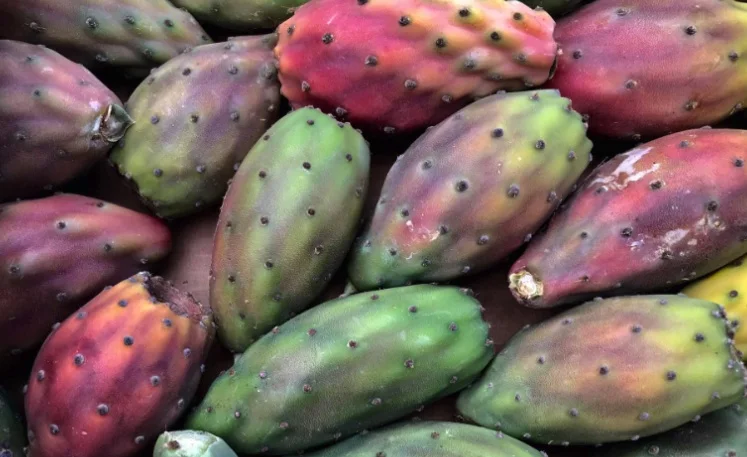
If we had to choose a plant that represents Sicily-colouring its fields and valleys-the answer would certainly be the prickly pear.
Yet, as its Italian name suggests, this plant is not originally from the Indian subcontinent but from the Americas-in particular Mexico, which still attributes strong symbolic value to it.
Accustomed to the arid climate of Central America, it adapted perfectly to Sicily, becoming a defining emblem of the island in very little time.
Painted across the rugged slopes of Mount Etna, the Etna Prickly Pear PDO has become a renowned excellence.
But today we are not on Europe’s highest volcano: we are instead in the Erei Mountains, at far lower altitude, where the provinces of Enna, Caltanissetta and Catania meet.
And it is in this latter province-its easternmost stretch-that the speciality at hand is produced: the San Cono Prickly Pear, awarded PDO status for its sweet, delicate flavour.
An eagle and a strange cactus
As mentioned, the prickly pear is not native to Sicily, despite its widespread presence.
Nor does it come from India, despite the misleading name. Columbus himself was deceived: he brought this unusual plant to Europe in 1493, upon returning from his first voyage of exploration.
That journey was meant to find a new sea route to India and the Far East.
Landing in the Caribbean, Columbus believed he had reached the Indies-hence the name prickly pear, which remains to this day.
We do not know precisely when this spiny shrub first appeared in the Americas, but we do know that the Aztecs were familiar with it and even revered it.
During their northern explorations, they encountered an eagle perched on a strange cactus and decided to found their capital, Tenochtitlan-meaning “land where the fruits of the cactus that rises from the stone abound".
That strange cactus was the prickly pear, which today appears on the Mexican flag beneath the eagle (symbol of life) defeating a serpent (symbol of death).
A feared “weapon”
The prickly pear arrived in Europe through colonial voyages, spreading rapidly across the Mediterranean-and especially Sicily.
According to folk tales, however, it was brought to Sicily by the Saracens as a means to annihilate the local population.
Frightened by its shape and the spines that cover it, farmers believed the fruit to be poisonous-an actual weapon of pagan destruction.
A painful delicacy
In reality, Opuntia ficus-indica-its scientific name, derived from the ancient polis of Opus-is not toxic at all.
It is, however, painful to handle, due to the large spines covering its paddles.
The paddles are the true branches of the plant-although they look like leaves.
The actual leaves are the long, sharp spines typical of cactus species, used to protect the succulent plant, which stores a large quantity of water.
Even more treacherous are the glochids: tiny, barbed spines that detach easily from the paddles and fruits but are very difficult to remove from the skin, often breaking off beneath the surface.
From ornamental plant to sweet fruit
Farmers’ fears were understandable given the plant’s outward appearance, and it took time before the fruit was finally embraced.
Initially, the prickly pear was used mainly as decorative greenery around homes and country estates, spreading naturally thanks to birds dispersing its seeds.
Only gradually did farmers overcome their hesitation and recognise its potential-so much so that agronomist Adrien de Gasperin described it as a true “manna”.
In the 19th century, prickly pear production greatly expanded, especially on the slopes of Etna, where the dry, rocky terrain is ideal for the plant.
The San Cono Prickly Pear PDO
In the area of San Cono and the Erei Mountains, however, the prickly pear cultivar arrived only in the 1970s. Yet local producers quickly transformed this once-spontaneous plant into a specialised crop, with plantations reaching up to 600 plants per hectare.
Farmers in San Cono, San Michele di Ganzaria, Piazza Armerina and Mazzarino shaped this agricultural excellence, levelling the terrain to prevent water stagnation-harmful to any cactus.
The scozzolatura tradition
A strong link to tradition remains in the technique of scozzolatura, which consists in removing (in June) the first inflorescences from the paddles to obtain larger, sweeter fruits known as scuzzulati or bastarduni.
For agostani fruits (those left on the plant from the first flowering), harvesting takes place from August to September. For the bastarduni, the harvest lasts until December.
After harvesting, the fruit must be de-spined using rollers that brush off the outer glochids.
Characteristics of the San Cono Prickly Pear PDO
The combination of skilled farmers and the natural characteristics of the Erei territory produces a high-quality fruit, available in three varieties:
- Sanguigna – featuring deep red pulp
- Sulfarina – with firm yellow pulp
- Muscareḍḍa – characterised by delicate white pulp
All varieties share exceptional sweetness. They are delicious eaten fresh and ideal for candied fruits, ice creams, jams and traditional sweets such as mustazzoli.
In recognition of its quality and uniqueness, the San Cono Prickly Pear has been granted PDO status.
The town of San Cono-now celebrated as the capital of the prickly pear-hosts a festival dedicated to the San Cono Prickly Pear PDO every October.
Curiosities
The scuzzulati fruits are also called bastarduni, because-according to legend-an envious farmer once cut off his neighbour’s prickly pear flowers, thinking he would cause damage. The result was the opposite.
The Aztecs called the sacred prickly pear “Napolli”.
In Sicily, farmers historically ate prickly pears during the grape harvest as a sign of devotion to God-or, more realistically, because landowners encouraged it to prevent them from eating the grapes.
One saying reflects this: Jinchi la panza e jinchila di spini (“Fill your belly and fill it with spines”).
In Sicily, prickly pears even grow on rooftops.
Life is like the prickly pear: you can’t reach its sweetness without first facing its thorns.