Overview
Provola is a stretched-curd cheese made from cow’s milk (or buffalo milk in certain prized versions), characterised by its rounded or pear-shaped form, elastic texture, and sweet, delicate flavour when fresh, becoming more intense as it matures. It belongs to the large family of Southern Italian stretched-curd cheeses, which also includes caciocavallo, mozzarella, scamorza and others. Sicilian provola has features closely linked to its territory, the milk used and the traditional techniques passed down through generations.
In Sicily, the production of provola is an important cheesemaking tradition, especially in inland and mountainous areas where cattle farming is practised. Provola is eaten fresh (after only a few days of maturation) or aged (from several weeks to several months), with characteristics that change accordingly. It is a versatile ingredient, used both in hot dishes where it melts beautifully (baked pasta, pizzas, parmigiana) and eaten on its own or in antipasti. Smoked provola, with its golden colour and characteristic smoky aroma, is particularly appreciated. Every Sicilian dairy has its own distinctive provole, an expression of local tradition and artisanal skill.
Characteristics
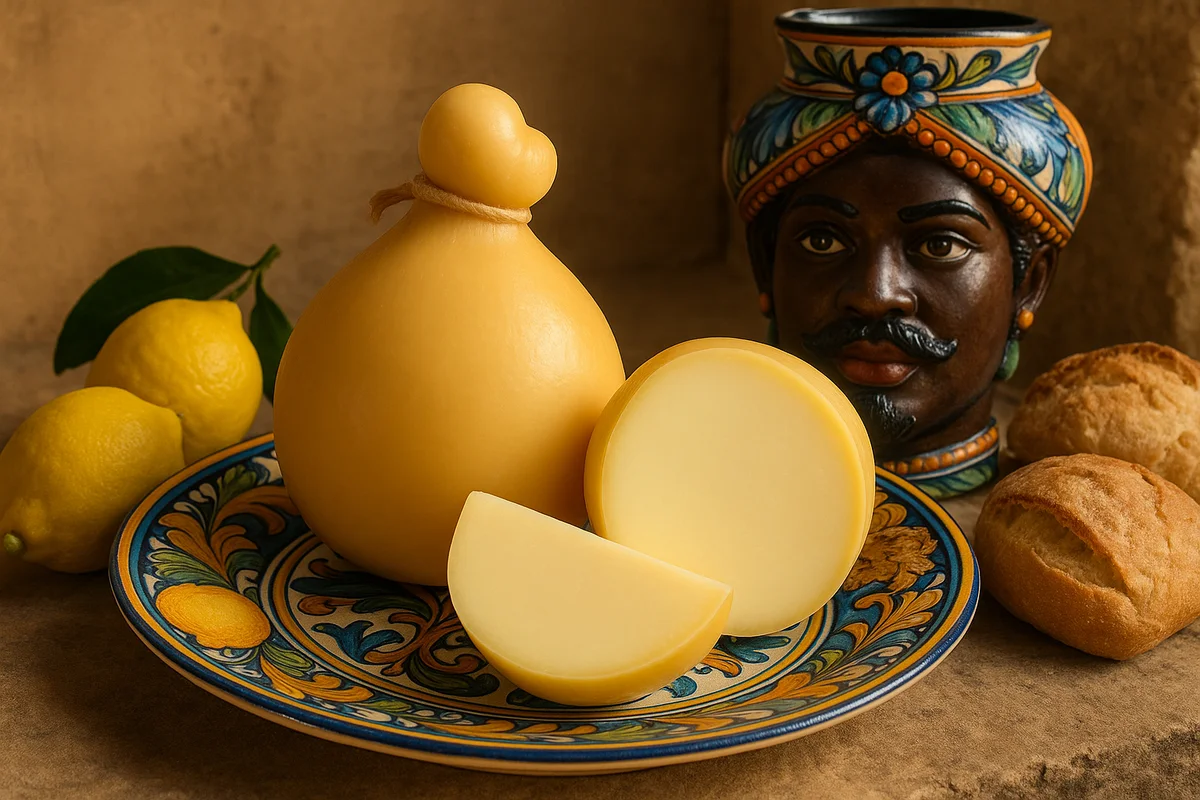
Provola typically has a rounded, slightly flattened or pear-shaped form (provolone), with sizes ranging from 200 g to over 1 kg. Its thin, smooth rind is white or golden if smoked, while the paste ranges from white to cream-coloured, compact and elastic. When fresh, its texture is soft and stretchy; when aged, firmer.
The flavour is sweet and milky in the fresh version, becoming more pronounced and savoury in the aged one, with characteristic smoky notes in the smoked variety. The aroma is milky and delicate when fresh, more intense when matured. High-quality provola has a homogeneous, elastic paste that melts beautifully when heated, with no lumps or defects.
Production
Provola is a stretched-curd cheese, made through the following characteristic process:
1. Cow’s milk is heated and rennet added to coagulate it.
2. The curd is cut into small pieces and allowed to release its whey.
3. The curd matures for several hours until reaching the right acidity.
4. Stretching: the curd is cut into strips and immersed in hot water (80–90°C), then pulled and folded repeatedly until a smooth, elastic mass is achieved.
5. The stretched paste is shaped (round or pear-shaped).
6. The cheeses are immersed in brine for salting.
7. Ageing: from a few days (fresh provola) to weeks or months (aged provola).
Smoked provola is exposed to wood smoke (traditionally straw or mild woods), which gives it its golden colour and distinctive aroma.
Types
Fresh provola
Aged for only a few days, it has a soft texture, delicate sweet flavour, and should be eaten within a week. Excellent fresh in salads or melted in hot dishes.
Aged provola
Aged for several weeks or months, it has a firmer texture and a more intense, savoury flavour. It keeps longer and may be grated or eaten in slices.
Smoked provola
Exposed to smoke, giving it a golden-brown rind and characteristic smoky flavour. Highly appreciated in Sicily. Eaten fresh or in cooked preparations.
Provola dei Nebrodi
Produced in the Nebrodi Mountains using the milk of locally raised, free-grazing cows. It has distinctive organoleptic qualities linked to the territory and is considered among the finest.
Provolone
The large-format version of provola (from several kilos to dozens), aged for months or years. It has a much stronger, tangier flavour. Not typically Sicilian, though some productions exist.
Use in Sicilian cuisine
Antipasti
Fresh or smoked provola is served in slices in antipasti, accompanied by cured meats, olives and preserved vegetables. It pairs beautifully with fresh tomatoes and basil.
Baked pasta
Diced provola enriches baked pasta, anelletti and timballi, melting into long, stretchy strands that bind the ingredients.
Parmigiana
In Sicilian aubergine parmigiana, provola alternates with or replaces mozzarella, creating flavourful, melting layers.
Pizza and focaccia
Smoked provola is a favoured ingredient on pizzas, lending a distinctive smoky note. It is used alone or alongside mozzarella.
Rolls and main courses
Slices of provola fill meat rolls, aubergine rolls and pepper rolls. It melts during cooking, creating a soft, molten centre.
Grilled
Thick slices of provola can be grilled briefly until lightly browned and partly melted. Served hot with salad or bread.
Fried
Breaded and fried provola (“mozzarella in carrozza” made with provola) is an indulgent preparation: crisp outside, melting inside.
Provola vs other stretched-curd cheeses
Mozzarella: Very fresh, unaged, extremely soft and moist, with an exceptionally delicate flavour; keeps only a few days.
Provola: Briefly or moderately aged, firmer texture, more pronounced flavour, keeps longer than mozzarella.
Caciocavallo: Similar to provola but aged much longer, with a firm texture and a far more intense, savoury flavour; often grated.
Scamorza: Similar to provola, with a more pronounced pear shape, often smoked, with an intermediate texture.
All share the stretching process but differ in ageing, texture and flavour intensity.
Storage
Fresh provola keeps in the refrigerator, in its brine or wrapped, for 5–7 days. Aged provola keeps for several weeks, wrapped in food-grade paper or cloth.
It should not be stored in airtight plastic for long periods, as it “sweats” and may deteriorate. Paper or cloth allows it to breathe. Smoked provola is stored like fresh or aged provola depending on its degree of maturation.
It may be frozen, but quality suffers: it becomes more crumbly and loses elasticity. Freezing is acceptable only for cooked uses where it will be melted.
Tips for purchasing
Check freshness and quality: an even, elastic paste without lumps, an intact rind, and a pleasant milky aroma, with no mould (unless intentionally part of a cheese, which is not the case for provola).
Choose artisanal provola from local Sicilian dairies for quality and typical characteristics. Industrial provola is more standardised and less distinctive. Taste before buying when possible to assess flavour and texture.
For cooked dishes where provola will be melted, even more economical versions are suitable. For eating on its own, choose higher-quality options.
Nutritional properties
Provola is a nutritious, calorie-dense food: 100 g provide about 280–350 calories (depending on ageing and fat content). It contains roughly 25–28 g of high-quality protein, 20–28 g of fat (mainly saturated), and zero carbohydrates.
It is rich in calcium (around 600–700 mg per 100 g), phosphorus, B vitamins (especially B12) and vitamin A. It is a complete protein source, excellent for growth and muscle maintenance.
It should be eaten in moderation due to its caloric value and saturated fat content. A reasonable portion is 40–50 g.
Provola in Sicilian tradition
The production of stretched-curd cheeses is an ancient tradition in Sicily, linked to cattle farming in inland areas. Each dairy had (and has) its own recipes and techniques, passed down within families.
Provola represented (and represents) a valuable, storable and saleable product. Rural families produced provola for their own use and for sale, an important source of income.
The characteristic pear shape with a small “head” (typical of caciocavallo and some provole) allowed cheeses to be hung in pairs (“a cavallo”) on rods for ageing and storage, from which names like caciocavallo derive.
Today, some Sicilian producers are rediscovering and valuing traditional techniques, using milk from Sicilian native cattle raised on pasture to produce cheeses of superior quality and strong territorial identity.