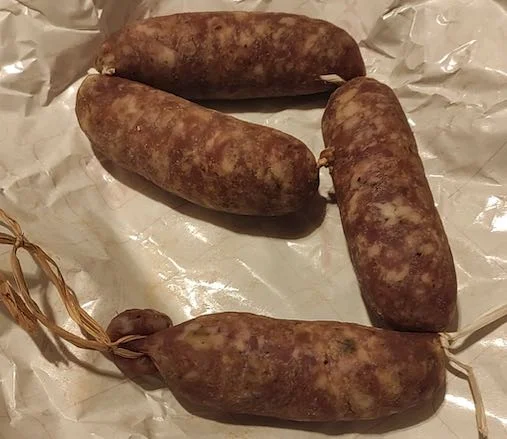
Pasqualora sausage (or sasizza pasqualora in Sicilian) is one of the many Sicilian food and wine excellences to which we devote special attention in these pages.
Many of these products, as with numerous traditional Sicilian recipes, are inseparably tied to specific times of the year. This is not due to natural maturation cycles alone, but rather to human custom: religious festivities were often chosen as moments for production or harvest, both for convenience and devotion.
This is the case for pasqualora sausage, which originates from the medieval custom of preserving sausages prepared at Carnival throughout Lent (during which meat consumption was forbidden), to be enjoyed at last on Easter Day.
From this tradition, however, pasqualora sausage later took an opposite path: certain cuts of pork were set aside, the animals then slaughtered during Holy Week, and the meat stuffed to be enjoyed in summer.
This tradition also includes the Partinico Pasqualora Sausage, on the border between the provinces of Palermo and Trapani, where an even more original version is made: lamb meat is added to pork, in keeping with an ancient pact between farmers and shepherds, which we shall explore later.
This Partinico Pasqualora Sausage is a unique Sicilian excellence, enjoyed both cooked and raw.
The lucanica
The Sicilian word sasizza derives from “salsiccia”, which itself comes from the Late Latin term salsicia, formed from salsicius (meaning salted) and insicia (minced meat).
Across Italy, different terms are used to refer to what is essentially the same product (though recipes may vary).
For example, in Lombardy the sausage-known in Sicily, the South and as far as Tuscany as “salsiccia”-is called salamella, while in the Triveneto area it is known as luganega.
This latter term reveals the history and birthplace of the sausage.
Although various Italian regions claim to be the homeland of sausage, its true origin is Lucania (modern-day Basilicata).
It was already consumed during the period of Greek colonisation, as evidenced by archaeological findings.
Any doubt is removed by Roman authors, particularly the historian and agronomist Marco Terentius Varro: in his De Re Rustica he describes a pork sausage seasoned with salt and spices, called lucanica because it was a typical Lucanian preparation.
According to authors such as Cicero, Apicius and Martial, lucanica was introduced to Rome by the famous Lucanian slave women, becoming highly appreciated in the capital.
Types of sausage
In the medieval period, as noted, lucanica became known as salsicia, and the sausage continued its long history for over two millennia to the present day.
Pork sausages stuffed into pork casings and seasoned with salt and spices are found in every region of Italy and beyond, with similar products in Germanic lands.
Many varieties exist, with recipes that change from village to village, though a broad distinction can be made based on the terminology used.
In Veneto and Friuli-Venezia Giulia, the luganega is common: it may be prepared with pork, but also horse or veal. It remains a very tender sausage.
Quite different is the Mantuan salamella, made with pancetta and pork shoulder, eaten only cooked, and now inseparable from stadium match days.
In Tuscany-the birthplace of the term “salsiccia”-sausages are made using the tenderest pork cuts, such as leg and shoulder.
The Sicilian sausage
In the South, the tradition of knife-cut sausage took hold: made from pancettone and culatello, not minced but cut into coarse pieces using the tip of a knife.
This method arose to prevent the heat generated by mechanical mincing from spoiling the meat; the expert use of a knife preserves the quality of meat that can even be eaten raw (though cooking is increasingly recommended).
Sicilian knife-cut sausage is made using leg, pancetta and shoulder, mixed thoroughly to avoid a fibrous texture.
The mixture is then seasoned with wild fennel seeds, black pepper and salt, and after an hour is stuffed into the casing.
The pasqualora sausage (PAT)
Pasqualora sausage follows this knife-cut method and preparation (using only pork), but differs in its production periods.
This product-already mentioned by Virgil in the Georgics-is recognised as a traditional agri-food product (P.A.T.). Its name derives from the custom of reserving pork for slaughter strictly during Holy Week.
The knife-cut meat is seasoned with salt, black pepper, wild fennel, chilli and white wine; stuffed into pork casing in a U-shape, it is then left to mature for two weeks, after which it is ready to be eaten either cooked (for example on the grill) or raw, like a salami.
Partinico Pasqualora Sausage
This tradition-once indicating the custom of eating the sausage at Easter after the Lenten abstinence-also reached Partinico, an important town in the province of Palermo, linking the area with nearby Trapani.
Here too, from ancient times, sausage has been prepared during Holy Week; however, this is the only case of knife-cut sausage in which lamb is added to pork.
This recipe stems from an established custom, a kind of ancient agreement between farmers and shepherds.
In a spirit of do ut des, shepherds received from the burgisi (local landowner) the right to pasture their flocks on his land. In return, they offered a lamb.
The lamb, however, was not ideal for long-term preservation, so the burgisi exchanged part of the lamb meat with the butcher in return for pork, making a mixed lamb-and-pork sausage.
Characteristics of the Partinico Pasqualora Sausage
This ancient tradition has survived to the present, still maintained by farmers in Partinico, even though sheep farming is now in decline.
The Partinico Pasqualora Sausage is characterised by the softness of lamb meat combined with the firmer texture of pork (which still accounts for 60%), and by the seasoning of salt, black pepper, wild fennel and Catarratto wine.
The mixture is stuffed into pork casing, divided with twine into caddozzi (sections), and left to mature.
The Partinico Pasqualora Sausage may be eaten cooked-such as grilled-or raw, like a salami.
Curiosities
Although literary sources recognise the Lucanian origin of sausage, various Italian regions have claimed its invention. Lombard tradition, for example, attributes it to Queen Theodolinda, who supposedly gifted the recipe to the people of Monza.
Over time, each region developed its own recipe.
The sausage of Bra is renowned, while in Emilia the “salsiccia matta” is made with meat infiltrated with blood, giving it a dark red colour reminiscent of a bruise-said to “madden” as it darkens over days.
Sausage also travelled beyond Italy, particularly to Germany.
In Bavaria, the sausage known as “Dachsund” was created-named for its resemblance to a dachshund.
Centuries later, German emigrants brought the recipe to America, where it became known as the hot dog.