Contents
Nubia’s red garlic is a special variety grown in Nubia, a small hamlet of around 600 residents just a few miles from Trapani, nestled within the Saline di Trapani nature reserve and the surrounding villages of Paceco.
Garlic through the ages
Red garlic from Nubia is just one of many garlic cultivars, known for its strong, lingering aroma. In fact, the renowned English playwright William Shakespeare once advised actors against eating garlic so they could address their audience with “sweet words” (A Midsummer Night’s Dream [IV,2, vv.43/44]).
Garlic’s history stretches back to ancient times. An Egyptian papyrus from the 2nd century BC reveals that garlic was not only a kitchen staple but also valued for medicinal uses, treating insect bites and headaches. Its healing reputation continued with Hippocrates, the famed Greek physician, who recommended garlic for its therapeutic benefits.
Following Hippocrates, the Roman writer Pliny the Elder also praised garlic’s medicinal virtues. It’s recorded that Roman generals used garlic to ward off infectious diseases. Even in the Middle Ages, garlic retained its fame, believed to protect against demons and witchcraft.
The Renaissance herbal manuscript, the Urbino Herbarium, reaffirmed garlic’s medicinal importance.
A more scientific understanding came in the 19th century when the French microbiologist Pasteur confirmed garlic’s medical properties.
During colonial times, garlic was used across Africa to treat dysentery, tuberculosis, typhoid, and cholera.
Today, garlic is produced in vast quantities in China, India, other parts of Asia, Russia, and the United States.
How it’s grown
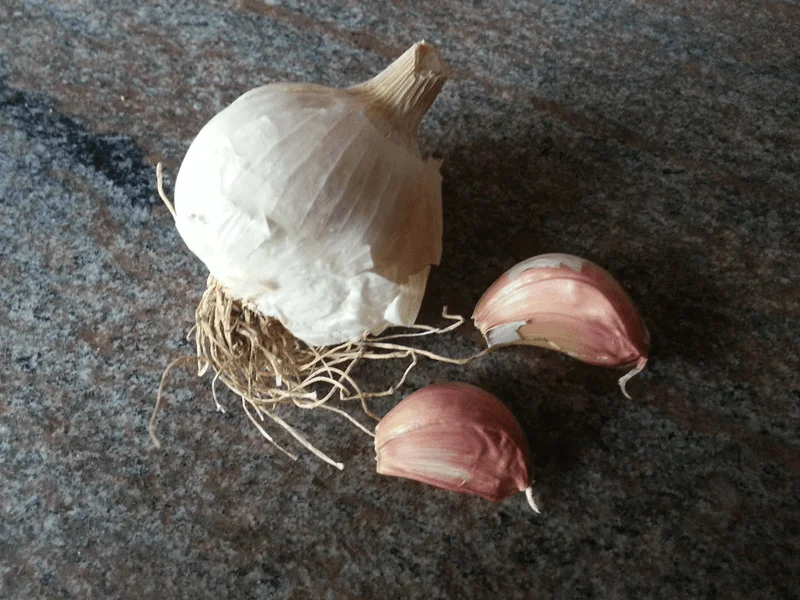
As mentioned, garlic (scientifically Allium sativum) is a bulbous plant from the lily family. It has sturdy fibrous roots and a smooth stem from which long green leaves sprout, sometimes reaching 60cm tall. Only the bulb is used, protected by outer leaves called “sterile tunics” that serve purely as a shield. Each bulb contains between 6 and 14 cloves, wrapped in thin, papery skins.
Garlic is planted either in November-December or February-March. The cloves—the reproductive parts—are buried 3-4cm deep, tips facing upwards. The soil should be well-drained and enjoy several hours of sunlight daily. Harvesting takes place when the leaves have completely dried, usually between July and August.
Harvesting is crucial: if bulbs are left in the ground, they will sprout the following year, overcrowding the soil. After lifting, the cloves are sun-dried on wooden crates, carefully shielded from rain and dampness.
Uses in the kitchen and beyond
Garlic is famed for its sharp, spicy flavour (its name derives from the Celtic word “all”, meaning pungent) and its distinctive aroma, caused by an amino acid called alliin, which contains sulphur.
It’s incredibly versatile—used to flavour sauces, pestos, and sautés, whether whole, chopped, crushed, powdered, cooked, or raw. Eating it raw is best to preserve its essential compounds and health benefits.
Garlic is antioxidant, antibacterial, and helps lower blood pressure. It can prevent colds, bronchitis, and tuberculosis, and is key in fighting high cholesterol (specifically LDL, or “bad” cholesterol). Some studies even suggest it has anti-cancer properties.
It also aids digestion and acts as a diuretic, often consumed as an infusion. Traditionally, garlic has long been regarded as a potent aphrodisiac.
Of course, excessive consumption can cause irritation to the gut lining and damage blood cells, potentially leading to anaemia.
The “Red of Nubia” variety
As mentioned, one of the best-known cultivars is Nubia’s red garlic.
Garlic comes in three types based on the colour of the sterile tunics: white, pink, and red. Nubia’s red garlic is distinguished by its striking red inner tunics that wrap each clove (the outer layers remain white) and typically contains 12 cloves.
This variety is usually planted between December and January. The cloves are sown upright in furrows made with a motorised tiller. Harvesting takes place from May to June, done at dawn or dusk when the cooler temperatures and moist leaves make it easier to pull the bulbs. At the same time, the flower stalk (known locally as the spicuna) is trimmed shortly after lifting.
Nubia’s red garlic is then gathered into large braids, sometimes holding up to 100 bulbs. These braids come in various sizes—Mazzunedda, Corrente, Grande, and Cucchiscedda—each differing by bulb count and diameter. They’re sun-dried, often hung from balconies to air out.
What makes Nubia’s red garlic special
Research from the University of Palermo shows that Nubia’s red garlic contains a higher concentration of allicin, an organic compound believed to help prevent cardiovascular disease and boost the immune system.
This garlic is a key ingredient in some of Trapani’s most beloved dishes, such as pesto alla trapanese (known locally as pasta cull’agghia) and fish couscous.
Today, around 60 producers cultivate Nubia’s red garlic, yielding roughly 1,800 tonnes annually. It’s grown across 320 hectares, not only around Nubia itself but also in nearby towns like Buseto Palizzolo, Valderice, Marsala, Trapani, and Salemi.
Thanks to its limited growing area, ancient roots, and health benefits, Nubia’s red garlic is listed among Italy’s Traditional Agri-food Products (P.A.T.). The Slow Food movement has championed it since 2002, and efforts are underway to secure Protected Geographical Indication (PGI) status for this extraordinary bulb.
Handy tips
Here are a few practical pointers for handling garlic.
To peel cloves quickly, simply crush them lightly with the broad side of a knife or blanch them for half a minute, then drain and cool under running water. To banish garlic smell from your hands, mix some coffee grounds into Marseille soap; alternatively, use a garlic peeler, a handy kitchen gadget designed just for this purpose.
After enjoying garlic, freshen your breath by chewing coriander seeds.
Given its long history and significance, especially during the Middle Ages, garlic has become more than just food—it’s woven into daily life and folklore. It features in many proverbs and literary works.
We’ve already seen Shakespeare’s nod. Here’s a Sicilian saying: ci voli l’agghia pi li vicini—you need garlic for your neighbours. In other words, a good telling-off now and then is necessary and even beneficial.