Overview
Mulberries are the fruits of the mulberry tree (Morus), a traditional feature of the Sicilian landscape that for centuries played an important role in the island’s economy thanks to silkworm farming. These elongated, intensely sweet and juicy fruits, ranging in colour from white to red to deep black-purple, are among the most distinctive flavours of the Sicilian summer. Children eagerly climbed the trees to pick them, returning home with hands and mouths stained by their vivid juice.
In Sicilian tradition, the mulberry tree was common in the countryside, along roadsides and in gardens. Its generous shade offered shelter during hot summer days, while the fruits were a free gift of nature, eaten fresh as a delicious snack or transformed into jams, syrups and homemade sweets. Although less commonly sold than other fruits, mulberries hold a special place in the hearts and memories of Sicilians, symbolising a childhood when one climbed trees and picked fruit straight from the branches.
Characteristics
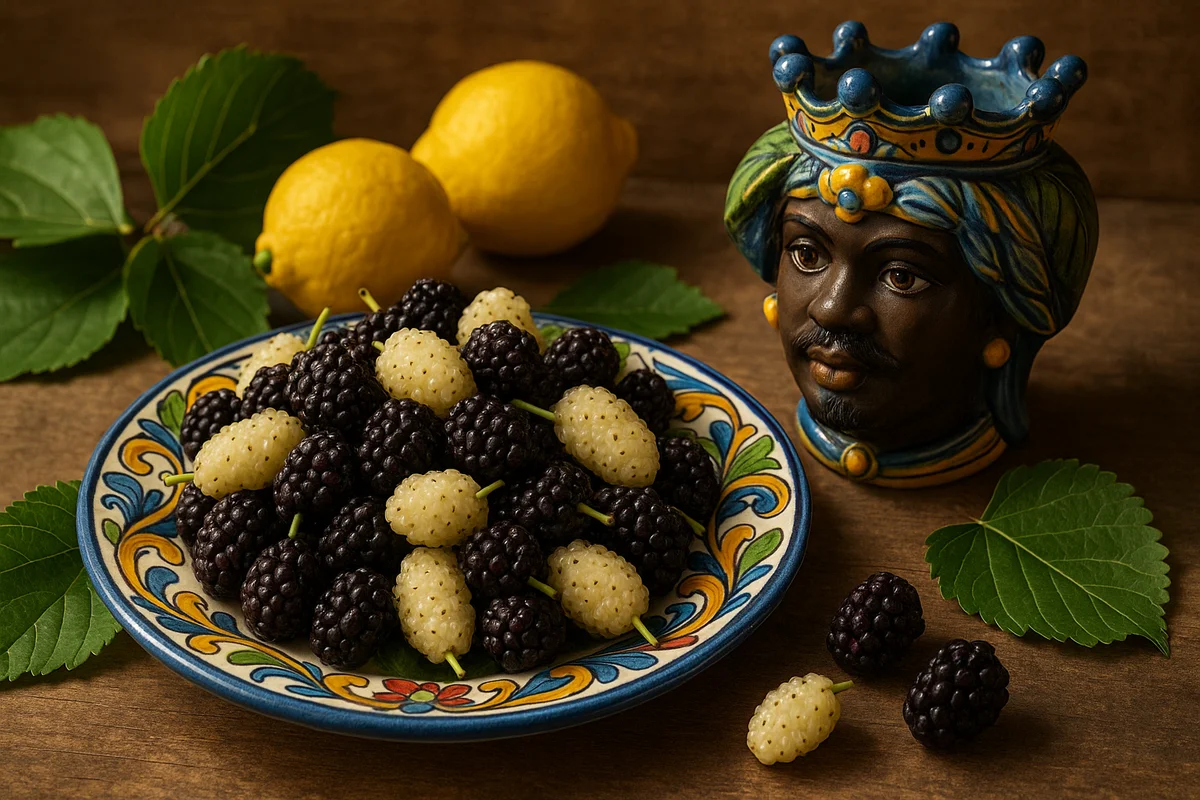
Mulberries are elongated compound fruits, similar to blackberries but more cylindrical, measuring 2–4 centimetres. They are formed by many small aggregated drupes. Their colour varies according to species: white-pink in the white mulberry, red in the red mulberry, and black-purple in the black mulberry.
The flesh is soft, juicy and intensely sweet, almost melting on the tongue. The flavour is deeply sweet with a slight tart note, more pronounced in the red and black varieties. The aroma is delicate and characteristic. Their texture is tender and extremely fragile: ripe mulberries crush at the lightest touch.
Ripe mulberries detach easily from the tree with a gentle touch. They have a deep, even colour, a soft but not mushy texture, and release a vivid juice that stains indelibly.
Varieties
White mulberry (Morus alba)
Produces white-pink fruits when ripe, very sweet and delicate. It is the mulberry traditionally cultivated for silkworm farming, as its leaves are the silkworms’ preferred food. The fruits are less commonly eaten than those of the black mulberry.
Black mulberry (Morus nigra)
Produces dark red or black-purple fruits, very juicy with an intense, slightly tart flavour. These are considered the most delicious mulberries. They leave deep purple stains on hands, clothing and mouth.
Red mulberry (Morus rubra)
An American variety less widespread in Sicily, with red fruits. It has characteristics intermediate between white and black mulberries.
Seasonality and harvesting
In Sicily, mulberries ripen between May and July, with peak production in June. Ripening is gradual: on the same tree fruits at different stages of maturity may be found, so harvesting can continue for several weeks.
Traditional harvesting involved climbing the sturdy branches of the mulberry tree. Ripe fruits detach easily, falling with the slightest shake. A practical method is to spread cloths beneath the tree and shake it gently, collecting the fallen fruits. Mulberries must be picked fully ripe as they do not ripen once harvested.
It is best to pick them in the cool hours of the morning, when the fruits are firmer and less delicate. Mulberries bruise extremely easily and must be handled with great care.
Use in cuisine
Mulberries have several uses in traditional Sicilian cuisine.
Fresh consumption
The most traditional and appreciated way to enjoy mulberries is fresh, just picked from the tree or well chilled from the refrigerator. They were a favourite summer snack for Sicilian children, eaten straight from the branches.
Mulberry jam
Mulberries are cooked with sugar and lemon to obtain a jam with an intense colour (dark purple for black mulberries) and characteristic flavour. It is a traditional way of preserving mulberries beyond their short season.
Mulberry syrup
From mulberry juice cooked with sugar comes a very sweet syrup used to prepare refreshing drinks, granitas, or to garnish ice creams and desserts. Black mulberry syrup has a spectacular deep red-purple colour.
Ice cream and sorbet
Mulberries are used to prepare brightly coloured, intensely flavoured ice creams and sorbets. These artisan specialities are cherished wherever mulberries are still cultivated.
Tarts and desserts
Fresh mulberries can decorate tarts and cakes, although their delicacy makes them difficult to handle. More common is the use of mulberry jam as a filling.
Smoothies and shakes
Blended mulberries with milk or yoghurt create colourful, nourishing drinks ideal for breakfast or as a snack.
Preparation
Mulberries must be handled with extreme care as they are extremely delicate. They should be washed briefly and gently just before use, by immersing them in cold water and draining immediately. It is best to avoid washing them under direct running water as they easily fall apart.
Any remaining stems should be removed. For cooked preparations such as jams, the mulberries may be lightly crushed to release their juice. For fresh consumption, they are used whole, taking care to avoid staining.
Mulberry juice stains skin and fabrics permanently. Fresh stains can be removed with cold water and soap if treated immediately, but once dry they become lasting. It is advisable to wear an apron when working with black mulberries.
Storage
Mulberries are among the most perishable fruits. They keep in the refrigerator for no more than 1–2 days, arranged gently in a single layer on a plate lined with absorbent paper. They should not be washed before storage.
It is important not to stack them, as they crush easily and release juice. They should be eaten as soon as possible, ideally on the day of harvest, when they are at their best.
Mulberries freeze well: spread on trays and frozen quickly, then transferred to containers. They keep for 8–10 months and are excellent for desserts, jams and smoothies. They may also be frozen as purée or with sugar.
Tips for purchasing and picking
Mulberries are rarely found on the market due to their extreme delicacy and perishability. If available, choose fruits with deep, even colour (white-pink, red or black-purple depending on the variety), soft but not mushy, and free from mould or fermentation.
The aroma should be sweet and fruity. Avoid mulberries with dried parts, mouldy spots or a fermented smell. Consume them as soon as possible after purchase.
The best way to obtain fresh mulberries is to pick them directly from the tree or know someone who has them. In some rural areas of Sicily, mulberries still grow along roadsides and in gardens, and their owners are often willing to share the harvest.
Nutritional properties
Mulberries are relatively low in calories: 100 grams provide about 40–45 calories. They are composed of roughly 85% water and contain around 10 grams of carbohydrates per 100 grams, mainly simple sugars. Protein content is about 1.5 grams, with minimal fat.
They are a good source of vitamin C, vitamin K and some B-group vitamins. They contain minerals such as potassium, iron, calcium and magnesium. They are rich in antioxidants, particularly anthocyanins (in black and red mulberries) and resveratrol, with anti-inflammatory and protective properties.
They contain fibre that supports intestinal regularity. They have diuretic and refreshing qualities. In Sicilian folk medicine, mulberries were considered beneficial for circulation and blood purification.
Mulberry leaves, in addition to being the food of silkworms, were used in traditional medicine to prepare infusions believed to be beneficial for diabetes and high blood pressure.
The mulberry and the silk tradition
The mulberry played a fundamental role in Sicily’s economic history due to its link to silkworm farming. Until the nineteenth century, sericulture was an important activity in Sicily, and mulberries were widely cultivated for their leaves, the exclusive food of silkworms.
Entire families were involved in raising silkworms and producing silk. White mulberries filled the Sicilian landscape. With the decline of sericulture, many mulberry trees were felled, but some centuries-old specimens still survive as witnesses to this tradition.
Curiosities
In Greek mythology, mulberries were originally white. They turned red (and later black) when stained by the blood of the lovers Pyramus and Thisbe, the tragic story told by Ovid in the Metamorphoses. This legend poetically explains the fruit’s intense colour.
In Sicilian tradition, climbing the mulberry tree to pick its fruits was a rite of passage for children. The tree’s sturdy branches were ideal for climbing, and finding a mulberry tree laden with ripe fruits was considered a stroke of luck.
In some parts of Sicily, it was customary to plant a mulberry tree at the birth of a child. The tree grew alongside the child, providing shade, fruit and—once—leaves for potential silkworms. Some of these “commemorative” mulberries survive today as centuries-old trees tied to family stories.
Mulberry trees were considered lucky. It was believed that having one in the garden would bring prosperity and abundance. The tree’s generous production of fruit was seen as a symbol of plenty and sharing.
During the Second World War, when food was scarce, mulberries were a precious source of free nourishment. Young and old would visit mulberry trees to gather the fruits, an important support in the difficult diet of those times.