The Sicilian olive-growing tradition has ancient roots, dating back to the time when the Phoenicians brought the olive tree to the island. For this reason, every valley has its own speciality, and many of these have obtained PDO status.
This is also the case for the excellence presented in this article: Monte Etna Extra Virgin Olive Oil PDO.
This oil is produced from olive trees growing on the slopes of Mount Etna, in an area that embraces the provinces of Catania, Enna and Messina.
The “gold” of the Mungibeddu displays a golden hue with green reflections, and offers a fruity character with a hint of spice.
From the Middle East
The history of olive oil in Sicily is millennia-old, as it reached the island at the beginning of the first millennium BC, when the Phoenicians transplanted the first olive trees.
These trees flourish in the Middle East, where the first evidence of the use of olive oil dates back to around 6000 BC.
At that time, olive oil was not yet used as a food but simply as an ointment.
From here the olive tree reached the Mediterranean and Egypt, and certainly also Palestine. The Gospels testify to this, describing how Jesus, after the Last Supper, went to the Mount of Olives.
Phoenicians and Greeks
As mentioned, it was first the Phoenicians who brought olive trees to Sicily. Later came the Greeks who, thanks to their well-known history of colonisation, helped spread olive-growing culture on the island and throughout Magna Graecia.
It was then thanks to the Romans that olive oil became widely known throughout the rest of the peninsula and beyond the Alps.
The Church and the bourgeoisie
Today Italian extra virgin olive oil is renowned worldwide, and Italy is the second largest producer.
The success of olive oil is owed in part to the clergy, who saved it from oblivion during a period when animal fats were preferred. The Church ensured the continued use of olive oil by employing it in liturgical rites.
A new impulse came from the rising Italian bourgeoisie-not only through trade, but also thanks to patronage, which promoted the use of oil in canvas painting.
The industrial revolution and, in the last century, the economic boom contributed to the extraordinary growth of Extra Virgin Olive Oil.
Extra Virgin Olive Oil
Italy has more than 40 protected designations of origin safeguarding olive-growing specialities, many of which are found in Sicily.
This includes Monte Etna Extra Virgin Olive Oil PDO, whose name derives from the volcano beneath which the olives flourish.
History of Monte Etna Extra Virgin Olive Oil PDO
In this area, the olive-growing tradition has a history spanning several thousand years.
The Phoenicians were the first to bring olive trees to the Ionic colonies, and the local farmers have always lived in close symbiosis with this tree of “golden fruits”.
This was true even during the Roman Empire, when imperial policy imposed heavy duties on oil from the Mungibeddu region, favouring competition from Campania and especially Lazio.
Despite this, olive cultivation in the area has seen steady, uninterrupted growth up to the present day.
The characteristics of the region
The excellence of this oil lies in the unique environment of Etna, characterised by terraced slopes supported by dry-stone walls.
The Nocellara Etnea cultivar (to which other varieties may be added in smaller quantities) grows from sea level to altitudes approaching 1000 metres, benefitting from consistently fresh, healthy winds.
This must be combined with the uniqueness of volcanic soil, which imbues everything that grows there with its fiery essence.
Properties of Monte Etna Extra Virgin Olive Oil PDO
Thanks to this combination of factors, the resulting oil is of the highest quality, with notably low acidity.
It is a true treasure, as suggested by its golden colour laced with marked green tones.
The flavour of Monte Etna Extra Virgin Olive Oil PDO is equally distinctive.
Its hallmark is a fruity aroma, perceptible on the nose, which gradually gives way to a pleasantly bitter and slightly spicy finish, never overpowering.
The harvesting of Monte Etna PDO olives
The journey that leads to extra virgin olive oil is long, the result of care and nourishment throughout the year.
Everything culminates in autumn, when the olive harvest begins. This takes place using small rakes that make the olives fall onto nets, facilitating collection.
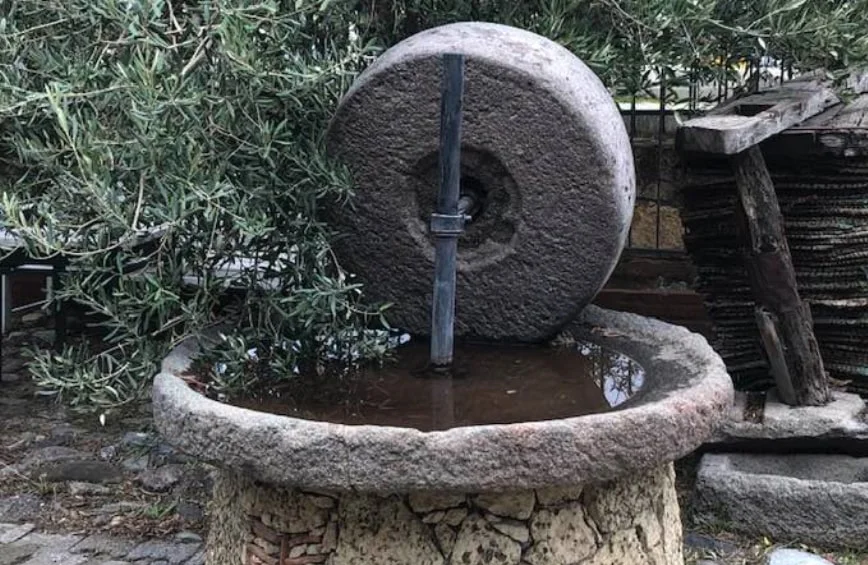
After careful washing, the olives are crushed in mills, ensuring the temperature does not exceed 28°C so as not to alter the oil’s organoleptic qualities and flavour.
Uses of Monte Etna Extra Virgin Olive Oil PDO
At the end of this long process, the oil is ready to reach tables across Italy. It is recognisable by the PDO mark, which must always be clearly visible.
Given its fruity and pleasant flavour, it is the perfect seasoning for bruschetta and salads, though it is also excellent in cooking.
A great culinary treasure of the whole Etna area-from Catania to Enna, through Messina-it is inevitably present at all local fairs and festivals.
Curiosities
The history of Monte Etna Extra Virgin Olive Oil PDO is closely tied to the volcano, where, according to myth, the Cyclops Polyphemus lived-and where he was blinded with an olive trunk.
Written evidence of the national and international acclaim of this speciality over the centuries comes first from Pietro Bembo who, in his “De Aetna”, praised the quality of oil produced on the volcano’s slopes; three centuries later, Tocqueville recognised the uniqueness of the Nocellara Etnea cultivar.
Olive oil is inevitably linked to many sayings in local tradition.
He who wants all the olives will not have all the oil.
God gives the olives and the farmer makes the oil.
Oil of one year, wine of one hundred years.