Overview
Among Sicily’s culinary jewels, one cannot overlook the chocolate of Modica, a delight from the enchanting town nestled in the province of Ragusa.
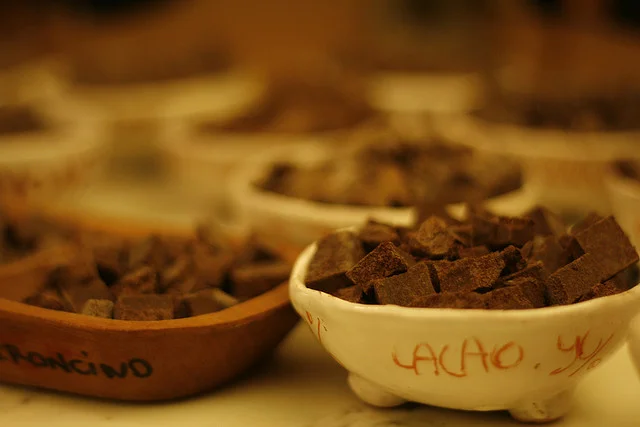
Modica chocolate stands apart thanks to its distinctive cold-process method that notably skips the conventional conching stage.
The usual conching method involves long mixing of ingredients (cocoa, sugar, vanilla, etc.) at controlled temperatures, aiming to smooth out any lumps.
In contrast, Modica chocolate retains its characteristic grainy texture, peppered with tiny sugar crystals that lend it a uniquely crumbly and granular bite.
The Cocoa Plant
Chocolate begins its journey from cocoa paste, made by processing cocoa beans.
These beans come from the fruit of the Theobroma cacao tree, whose pods bear a vague resemblance to large citrons.
The cocoa plant first appeared over 6,000 years ago near the great rivers of Latin America—the Amazon and Orinoco.
However, its cultivation took off only around the late 2nd century BC, spanning a broad region from Guatemala through Chiapas to Yucatán.
The Maya and Aztecs
The Maya were among the earliest to embrace cocoa, delighting in rich, hot cocoa beverages. The word “cacao” springs from their language—"chacauhaa"—a blend of “haa” (water) and “chacau” (hot).
A Maya legend credits King Hunahpu with introducing its cultivation.
Meanwhile, a more poetic Aztec tale speaks of a princess left guarding her husband’s treasure during wartime, who was tragically slain for keeping the secret safe. From her blood sprang the bitter yet resilient cocoa plant, mirroring the princess’s strength and sorrow.
This legend reveals how the Aztecs revered cocoa, associating it with Xochiquetzal, the goddess of fertility, and using it not only as a drink but also as incense.
The Aztec drink, known as “xocoatl,” was often spiced with pepper and chilli; beyond its rich flavour, it was said to ease fatigue thanks to its theobromine content.
Cocoa was never a humble staple; it was a luxury reserved for the privileged, with cocoa beans even serving as currency.
Chocolate’s Arrival in Europe…
Between the late 15th and early 16th centuries, Italian explorer Christopher Columbus brought cocoa beans back to Spain from Honduras. However, their bitterness meant they were initially dismissed.
The cocoa craze truly ignited thanks to Hernán Cortés, who, hailed as the god Quetzalcoatl by Emperor Montezuma and his people, was gifted a whole cocoa plantation.
The Spanish monks ingeniously refined the bitter Aztec recipe by removing chilli and pepper, adding vanilla and sugar instead, thus sweetening this exotic treat.
The tradition of making solid chocolate bars—typical of Mexico and created by grinding cocoa beans on a stone slab called a metate—found its way to the County of Modica during Aragonese rule.
To this day, this distinctive chocolate is crafted exclusively in Modica, making Modica chocolate truly one of a kind.
Soon after, chocolate crossed the Strait of Messina, captivating other Italian regions.
From this point, its popularity spread rapidly through France and England.
The Dutch, adept sailors themselves, seized control of the cocoa trade, challenging Spanish dominance.
Chocolate soon became a fixture in “coffee houses” across Europe. Rising demand spurred expansion of cocoa plantations in Brazil, Venezuela, and the Philippines.
The first modern chocolate praline is credited to Doret in Turin, where Prochet later combined cocoa with chopped hazelnuts to create the famous Gianduja paste.
By the mid-19th century, Daniel Peter, his father-in-law, and neighbour Henri Nestlé innovated by introducing milk to chocolate.
The process of conching was invented in 1879, enabling the creation of smooth, dark chocolate.
In the aftermath of World War II, chocolate production temporarily declined as plantations were neglected amid the global conflict.
The Rise of Cocoa Consumption
Recent studies reveal that chocolate consumption in Italy has grown by 19% in recent years. British researchers estimate the average Italian devours around 4kg of chocolate annually—whether in bars, pralines, Easter eggs, ice creams, mousses, or snacks.
While Switzerland leads global chocolate production, Italy is renowned worldwide for certain cocoa marvels—most notably the chocolate of Modica.
What Makes Modica Chocolate So Special
As mentioned, Modica chocolate traces its roots to the Spanish, who adopted the practice of making solid chocolate bars from the Aztecs.
It boasts a deep, intense black colour and an unmistakably grainy texture dotted with sugar crystals, lending it a brittle crunch and a subtle marbled sheen.
The traditional method has remained untouched: cocoa (typically sourced from beans grown in São Tomé, Africa) is ground without separating from the cocoa butter and gently warmed to 40°C.
It is then blended with sugar, cinnamon, vanilla, or lemon zest.
Despite these additions, the cocoa content stays remarkably high—ranging between 65% and 90%.
In handcrafting the chocolate, the mixture is placed on a crescent-shaped surface known locally as the “valata ra ciucculata” and worked with a distinctive stone rolling pin called “lu pistuni.” The thickness varies throughout the different stages, ending with a final step called “stricata.”
Maintained consistently at a gentle 40°C to preserve the sugar crystals, the blend is poured into rectangular tin moulds called “lanni.” These are gently tapped to ensure the chocolate takes shape and releases any trapped air bubbles.
And there you have it—the finished bar of Modica chocolate.
PGI Status and Festivals
In 2003, the Modica Chocolate Protection Consortium was established to secure the product’s PGI (Protected Geographical Indication) status, officially granted by the European Union in 2018.
Between 2005 and 2008, the town of Ragusa hosted Eurochocolate, a festival entirely dedicated to this delectable treat.
Thereafter, Modica launched its own event, Chocobarocco.
Alongside its illustrious cousins from Perugia and Turin, Modica chocolate even earned a stand at Expo Milano 2015, achieving impressive sales.
Fascinating Chocolate Facts
With its venerable history, chocolate carries many stories worth telling.
For instance, in the chilling shower scene of Stanley Kubrick’s film “Psycho,” the blood was actually chocolate.
And who could forget the much-loved book, adapted into the film “Charlie and the Chocolate Factory,” centred entirely on this luscious delight.
Countless sayings and proverbs celebrate this wonderful food.
“Life is like chocolate, it’s the bitter that makes the sweet worthwhile.”
“Life is like a box of chocolates, you never know what you’re gonna get!” (From the film “Forrest Gump”)
“All I need is love. But a little chocolate now and then doesn’t hurt.” (Lucy van Pelt, Peanuts)
Nine out of ten people love chocolate; the tenth is lying!