
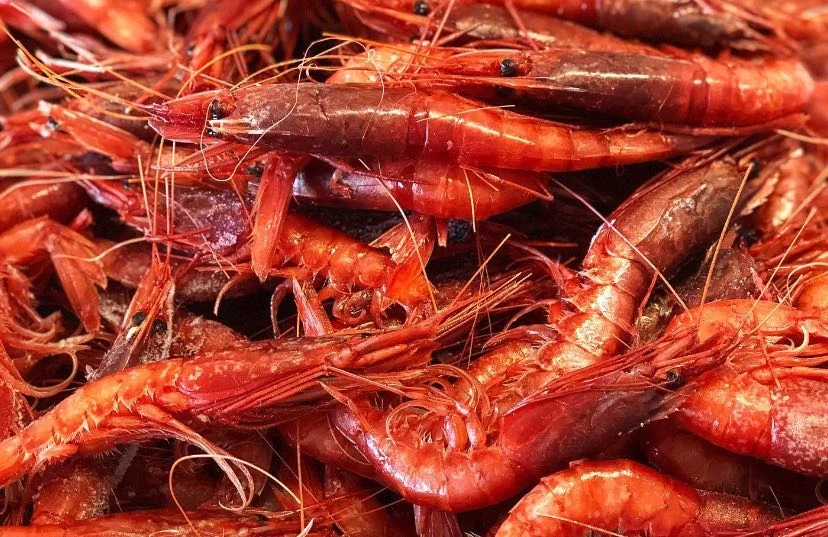
In the waters of the Mediterranean Sea grows the renowned Mazara Red Prawn, also known simply as the “Mazara Red”.
This variety of prawn is easily recognizable by its sweet flavor (which makes it highly appreciated) and, above all, by its bright red color.
Beloved by chefs around the world, it is the star of countless Sicilian recipes.
A relative of crabs
The red prawn is scientifically named Aristaeomorpha Foliacea, and it is a species that inhabits the Mediterranean Sea (and beyond), as we will see later on.
It belongs to the wider family of prawns, crustaceans that together with crabs and hermit crabs form the order of decapods (literally “ten-legged”). Unlike crabs and hermit crabs, prawns have a more elongated body. They are nocturnal animals that hunt their prey using their claws and the long antennae extending from their head, which detect vibrations produced by other living creatures.
As a crustacean species, they possess a carapace-an extremely resistant exoskeleton that protects them from external attacks. This carapace undergoes three molts a year, during which reproduction takes place. After fertilization, the eggs remain attached to the abdomen of the specimen until hatching.
Many kinds of prawns
The word “prawn” refers to a wide variety of crustaceans. The term is used to indicate both saltwater and freshwater species.
There is often confusion between prawn, shrimp, and king prawn.
The king prawn, for example, includes species such as Metapenaeus intermedius. Shrimp, on the other hand, refers to smaller species such as Palaemon elegans.
Other species similar to prawns exist but are known by different names: an example is the “mazzancolla”, which in Sicily is often called “bearded prawn” or “imperial prawn”.
When referring specifically to prawns, the term is often followed by an adjective that highlights a distinctive trait-usually the color. Thus we have the grey prawn, common in the Mediterranean but even more widespread in northern waters, and the red prawn. Besides the Mazara variety, there is also the so-called purple prawn: it is actually reddish, but with subtle violet hues.
The red prawn
Alongside the purple prawn, which inhabits the Mediterranean, we find the red prawn.
Aristaeomorpha Foliacea prefers muddy seabeds and is found not only in the Mediterranean but also in the waters of the Atlantic Ocean (particularly the Gulf of Mexico), in the seas between Australia and New Zealand, and along various African coastlines.
This species can exceed 20 cm in length. Its distinctive feature is the spiny carapace, with a brilliant red coloration reminiscent of coral. In summer, however, the head of the red prawn turns black due to the presence of eggs, which are used to produce a prized caviar-just as esteemed as the flesh itself. The meat is exquisite, firm yet succulent, and notably sweet.
Fishing the Mazara Red Prawn
Despite its name, the red prawn is not actually fished in the waters surrounding the town of Mazara del Vallo. Instead, it is from here that the long journey of the Mazara fishermen begins-a voyage that can last for months. The name of this excellence refers not to the fishing area but to the fishermen’s skilled hands and their preservation method. But let’s proceed step by step.
The fishing boats depart from Mazara del Vallo’s canal port (the only one of its kind in Sicily), in a western Sicilian town entirely devoted to its fishing fleet-the largest in Europe. From here, Mazara’s expert fishermen navigate toward Turkish and Cypriot waters-although until a few years ago they went far beyond the Strait of Gibraltar and into the Atlantic. Here, throughout the year but especially from late spring through summer, red prawn fishing takes place using trawl nets, perfectly suited to scanning the muddy seabeds where the prawn thrives at depths of at least 700 meters.
The Giacalone method
Once caught, some fishermen choose to freeze the prawns only upon returning to port-but doing so causes them to lose much of their organoleptic properties, even if they remain edible. For this reason, the Giacalone family introduced the Rosso di Mazara brand, which requires instant freezing at −50 °C, preserving all the nutritional qualities of the prawn throughout the long journey home.
This method is scientifically validated and endorsed by the Institute of Food, a British research body that has confirmed how frozen fish products retain their organoleptic properties better than fresh ones.
Size grading
Before freezing, the Mazara Red Prawn is carefully sorted by size, based on the measurement of the head. A specimen is considered first grade when the head exceeds 50 millimeters; the threshold for second and third grade is 40 millimeters.
How to enjoy the Mazara Red Prawn
Given its unmistakable flavor-enhanced by onboard freezing that preserves all the sea’s natural salinity-the best way to enjoy the Mazara Red is raw, or prepared as tartare or carpaccio.
It can also be used in cooked dishes, whether first or second courses, as long as cooking does not exceed one minute per side; beyond this, the meat would toughen and lose its delicate taste.
The Mazara Red Prawn also appears in traditional Sicilian recipes, such as pasta with prawns and Bronte pistachio.
Fun facts
The red prawn, which prefers darkness, is rich in vitamin B12, essential for healthy red blood cells.
Prawns are hermaphroditic animals, born male and later transforming into female. Their characteristic backward walk has inspired many sayings.
The prawn always walks backward, as if searching for a past in which to grow young again (Caramagna).
The shrimp that falls asleep is carried away by the current.