In film and everyday chat, we often say “good on the first go”.
But that’s not quite the case with today’s culinary star, which still relies on the age-old technique of scozzolatura: trimming the first blossoms of the fruit to encourage larger, juicier harvests.
We’re talking about a traditional practice linked to the prickly pear, a plant originally from the Americas but now a true emblem of Sicily, thanks to the remarkable transformation it underwent on the island.
Particularly famed are the ficurini (the Sicilian name), which flourish at the foot and on the slopes of Europe’s tallest volcano.
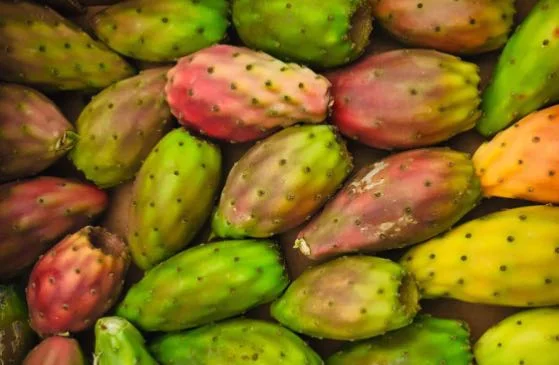
The fruits come in three different hues depending on the variety, yet all share a luscious, juicy flesh and a wonderfully sweet, rich flavour.
This prized fruit has earned the coveted DOP status, a testament to its singular quality.
A prickly plant with a sting
The Etna variety belongs to the Opuntia ficus-indica species, part of the broad Cactaceae family, better known as cacti.
Like its cactus cousins, the prickly pear is a succulent, storing vast amounts of water within its thick pads.
To fend off thirsty animals, the prickly pear has developed sharp, painful spines—though not all varieties bear them.
What really troubles people, however, aren’t the spines on the so-called pale—the flat, leaf-like branches of the prickly pear—but the tiny glochids.
These are minuscule, bristle-like spines found both on the pale and the fruit itself.
They’re barbed, detach easily—even with a gust of wind—and are notoriously tricky and painful to remove from the skin, as they break off readily.
In spring, the pale burst into bright yellow flowers, which give way in summer to the fruit, studded with these pesky spines.
A symbol of Mexico
This uniquely shaped fruit owes its scientific name to the ancient Greek city of Opus, as recorded by the historian Livy.
Research suggests the plant originated in the New World, particularly in regions of present-day Mexico inhabited by the Aztecs, who called the fruit “Nopalli”.
For the Aztecs, the plant was (and remains) sacred, rich in symbolism.
Legend has it that during one of their northern expeditions, the Aztecs spotted an eagle perched atop a bizarrely shaped cactus, deciding there to found their new capital: Tenochtitlan, meaning “the place where the fruit of the cactus grows on the rock”.
That cactus was none other than the prickly pear, which today features on the Mexican flag beneath the famous eagle—a symbol of the sun and life—triumphing over death, represented by a serpent.
The Saracen’s weapon
Historically, the prickly pear reached Europe thanks to New World explorations, notably in 1493 when Christopher Columbus returned to Lisbon.
Its name likely stems from its resemblance to the common fig, combined with its revolutionary geographic origin.
Early explorers, seeking new routes to India and China, mistakenly believed they had landed in the Indian subcontinent, hence the term “Indians of America” and the name prickly pear.
Others argue the prickly pear arrived in Sicily centuries earlier, brought by Saracens and Arabs.
Local legend held that lu peri di ficurinia was a poisonous plant introduced by the Saracens to harm Sicilians, but divine intervention transformed these pagan plants into sweet, fruitful trees.
In truth, the prickly pear came from the Americas and quickly spread as an ornamental plant rather than a food source.
Over time, aided by birds dispersing seeds, it spread throughout the Mediterranean basin. Eventually, farmers overcame their fear of the spines and tasted the fruit, becoming enchanted.
From then on, the prickly pear became a staple, naturally spreading across the island, breaking up olive groves and adorning country homes like a living ornament.
The scozzolatura of Etna’s prickly pear DOP
Like all cacti, this plant thrives in dry, coarse soils and requires little water or fuss.
Yet Sicilian growers have perfected a technique to improve the fruit: scozzolatura (or scutulata), which involves snipping off the first flowers that bloom on the pale between May and June, encouraging larger subsequent blossoms and fruits.
This ancient method is still practised by farmers harvesting the Etna prickly pear DOP, which grows within the Etna natural park, spanning the towns of Belpasso, Paternò, Camporotondo, Ragalna, Santa Maria di Licodia, Adrano, Biancavilla and Bronte.
The second crop is gathered from mid-August through to December.
After hand-picking with special tools called coppi, the fruit is passed through rollers that brush away the spines without damaging the tender flesh inside.
Varieties of Etna prickly pear DOP
Three varieties grow wild on Etna’s foothills: sanguigna, sulfarina and muscareḍḍa.
The sanguigna boasts a deep red, juicy pulp, as its name suggests.
The sulfarina offers a firmer, yellow flesh.
Lastly, the muscareḍḍa features a delicate white pulp. In all three, the sweet, fresh interior is guarded by those notorious spines.
Thanks to its sweetness, the Etna prickly pear DOP makes a perfect snack and is the base for the traditional rosolio liqueur.
It’s also used in jams, candied treats, ice creams, and Sicilian cakes like mustazzoli.
Celebrated at the annual festival in Belpasso every October, the Etna prickly pear proudly carries its prestigious DOP label.
Curiosities
Fruits that grow after the scozzolatura are called “scuzzulati” or “bastarduni”.
The latter name comes from a tale of a jealous farmer (the bastarduni) who cut the first blossoms, hoping to ruin his neighbour’s crop.
But after the rains, even bigger, juicier fruits appeared.
As mentioned, the prickly pear was initially feared by farmers as poisonous.
Divine intervention was said to have transformed it into a delicious fruit, and during harvest, farmers would feast on plenty of prickly pears as a sign of gratitude.
In reality, landowners would sweeten their workers with sugar to keep them from nibbling the grapes they were picking.
This gave rise to one of many sayings about the prickly pear: Fill your belly, but be ready for the spines.
And another:
Life is like the prickly pear: you must face the spines before reaching the sweet flesh.
In Sicily, prickly pears even grow atop house roofs, adding a splash of green to the skyline.