Overview
Cherries, known in Sicilian dialect as “cirasi”, are the fruits of the cherry tree (Prunus avium for sweet varieties and Prunus cerasus for sour cherries). In Sicily these fruit trees grow mainly in the hilly and mountainous areas of Etna, the Nebrodi and the Madonie. These small fruits, with their bright red or deep crimson hues, are among the most eagerly awaited pleasures of late spring and early Sicilian summer.
In the island’s traditions, cherries have always held a special place: eaten fresh as a refreshing, irresistible treat, used in patisserie to decorate cassate and cakes, preserved in spirits for Christmas sweets, or transformed into jams and syrups. Their sweet yet gently tart flavour, juicy flesh and inviting shape make them beloved by both adults and children.
Characteristics
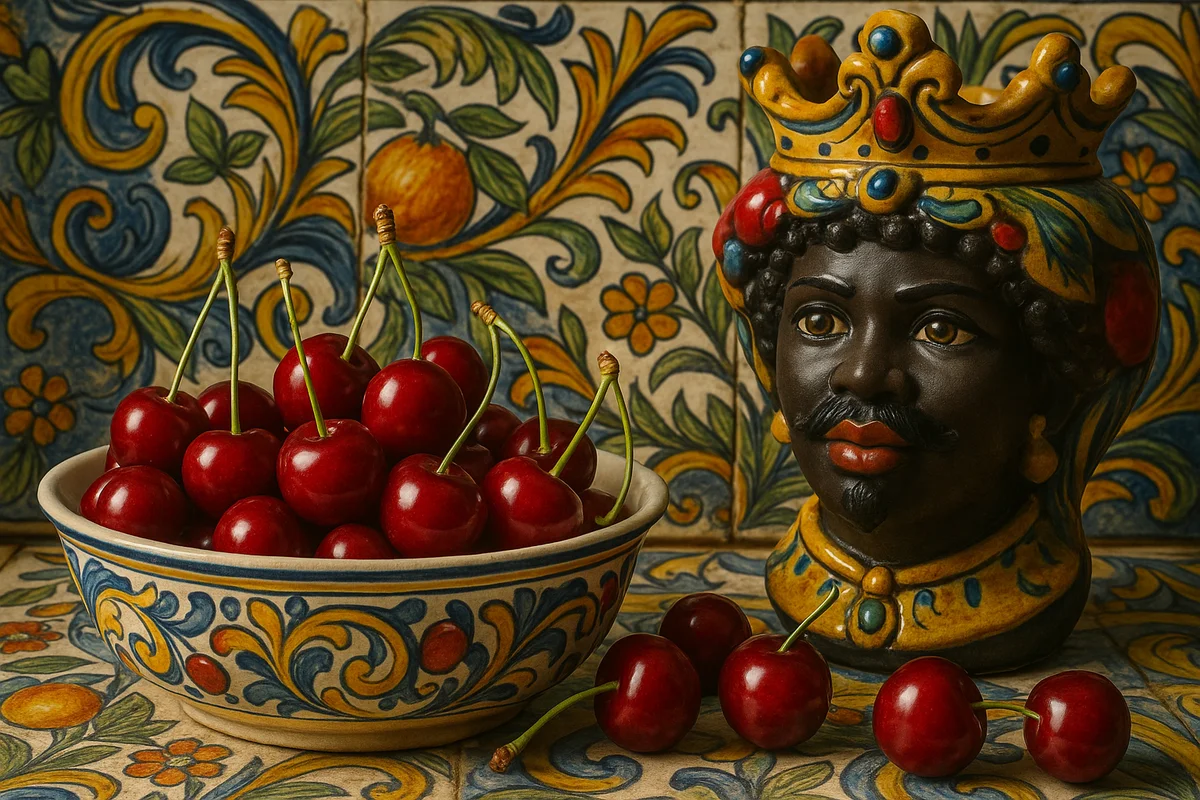
Cherries appear as small round or slightly heart-shaped fruits, 1–2 centimetres in diameter, attached to a long green stalk. Their colour ranges from bright light red to deep, almost black red, depending on the variety and degree of ripeness. The skin is thin, smooth and glossy, almost waxy in appearance.
The flesh is firm, juicy and crisp in the best varieties, with a hard stone at the centre. The flavour is sweet with a touch of acidity that varies according to the type: sweet cherries are predominantly sugary, while sour cherries and morello cherries have a sharper, slightly bitter tang.
The aroma is delicate, fruity and distinctive. High-quality cherries have a fresh green stalk, not dry or darkened, unblemished skin without bruises, and firm flesh to the touch.
Varieties
Duroni
Large cherries with firm, crisp flesh and a deep red or black colour. They are heart-shaped and have an intensely sweet flavour. They are the most highly prized for fresh consumption. In Sicily several types of duroni are grown, particularly in the Etna area.
Tenerine
Smaller, more delicate cherries with soft, juicy flesh and a bright red colour. They have a sweet, aromatic flavour. More fragile and perishable than duroni, they are wonderfully fragrant and perfect for jams and preserves.
Sour cherries
An acidic variety with dark red fruits and juicy flesh marked by a tangy, slightly bitter flavour. They are used primarily for preserving in spirits, for jams, and for the preparation of liqueurs and syrups. They are not eaten fresh but only once transformed.
Morello cherries
Similar to sour cherries but smaller and darker, almost black. Their flavour is very tart and they are used in sweet preparations and liqueurs. In Sicily they were traditionally gathered in woodland areas and made into homemade preserves.
Seasonality
In Sicily the cherry season begins in late April to early May in the warmer, lower areas and continues until June–July in the mountainous zones of Etna and the Nebrodi. The first cherries are the most anticipated and often the most expensive. The peak of production and quality occurs between mid-May and mid-June.
Mountain cherries, which ripen later thanks to the cooler climate, are often considered the most flavourful and fragrant. Harvesting must take place at the right point of ripeness, when the fruit has reached its full colour and sweetness while still maintaining firm flesh.
Use in the kitchen
Cherries have countless uses in Sicilian cookery and patisserie.
Fresh consumption
The simplest and most appreciated way to enjoy cherries is fresh, just picked or well chilled from the refrigerator. In Sicily it is traditional to serve cherries as a dessert at the end of a meal during their season, often presented in baskets or bowls over ice.
Cherries in spirits
A traditional preparation in which whole cherries are preserved in alcohol with sugar and spices. They are used to decorate cassate, cakes and ice creams, and are indispensable during the Christmas festivities. Every family has its own cherished recipe.
Cherry jam
Cherries are cooked with sugar until a dense, aromatic preserve is obtained, ideal for filling tarts, biscuits and pastries. Sour cherry jam has a more intense and tangy flavour.
Cherry syrup
From cherry juice cooked with sugar comes a sweet syrup used to make refreshing drinks, to top ice creams and granitas, or as a base for cocktails.
Decorating desserts
Fresh or candied cherries decorate cassate, cannoli, cakes and pastries. The bright red cherry atop a Sicilian cassata is an iconic and essential detail.
Clafoutis and cakes
Pitted cherries are used to prepare rustic cakes, clafoutis and tarts. Sicilian tradition includes cherry cakes with shortcrust pastry and soft cherry tarts.
Preparation
Cherries should be washed gently under cold running water shortly before eating, not too far in advance to avoid softening. They are dried by dabbing with a clean cloth. The stalk is left attached until the moment of consumption to help preserve their freshness.
To pit cherries, one may use a dedicated cherry pitter or, in its absence, a wooden stick or rigid straw, pushing through the fruit to expel the stone. For preserves and jams, it is important to pit all cherries carefully.
For preparations in spirits, cherries must be selected with perfect skin, free from bruises, washed and dried thoroughly. They are left with the stalk attached, which makes them easier to remove from the jar.
Storage
Fresh cherries are delicate and highly perishable. They keep in the refrigerator’s fruit drawer for a maximum of 3–5 days. It is important not to wash them before storing, only before eating, and to keep them with the stalk attached whenever possible.
They should not be piled in deep containers but arranged in one or two layers to prevent those at the bottom from bruising. They may be stored in perforated paper bags or open containers.
Cherries freeze very well: they should be washed, dried, pitted and arranged on a tray in the freezer. Once frozen, they can be transferred into bags. They keep for 10–12 months and are ideal for desserts and jams.
Cherries in spirits, jams and syrups keep for years if prepared correctly and stored in sterilised jars in a cool, dark place.
Tips for purchasing
When buying fresh cherries, choose fruits with a green, fresh stalk, not dry or darkened. The skin should be smooth, glossy and intact, without bruises, cracks or dark spots. The colour should be even and vivid, a sign of full ripeness.
Cherries should be firm to the touch but not hard, with flesh that yields slightly under gentle pressure. Avoid soft, wrinkled fruits or those showing signs of mould. A good indicator of freshness is the stalk: if it detaches easily leaving a small hole, the cherry is fresh; if it pulls away with part of the flesh, it is over-ripe.
Prefer locally grown, seasonal cherries, ideally purchased directly from producers or at farmers’ markets. Sicilian cherries, especially those from Etna, have exceptional organoleptic qualities thanks to the volcanic soil and climate.
Nutritional properties
Cherries are relatively caloric for fresh fruits: 100 grams provide around 50–63 calories depending on the variety and degree of ripeness. They are composed of about 80% water and contain approximately 12–16 grams of carbohydrates per 100 grams, mainly in the form of simple sugars (fructose and glucose).
They are a good source of fibre (about 1.5–2 grams per 100 grams), which supports intestinal transit. From a vitamin perspective, they contain vitamin C, vitamin A, folic acid and B-group vitamins. They are rich in potassium, important for regulating blood pressure, and also contain calcium, magnesium and phosphorus.
Cherries are particularly rich in antioxidants, especially anthocyanins responsible for their red colour, which have anti-inflammatory and protective properties. They also contain natural melatonin, which may support sleep. They have diuretic and purifying qualities.
In Sicilian folk medicine, cherries were considered beneficial for purifying the blood, for rheumatism and for promoting diuresis. Dried cherry stalks were used in infusions as a diuretic and cleansing remedy.
Curiosities
In Sicily there is a saying: “In cherry season, one cannot tell which is redder”, referring to the abundance and beauty of these fruits during their peak.
In the Etna region, cherry picking was a festive event involving whole families. People climbed the trees using ladders and baskets, and the day ended with outdoor meals beneath the trees. Eating the first cherries of the season was considered a good omen.
An old Sicilian children’s game involved tying two cherries joined by their stalks to the ears as earrings, creating a natural ornament proudly worn during harvest time.
Cherries in spirits were traditionally prepared by Sicilian families between May and June in anticipation of the Christmas festivities. Each household had its own secret recipe, passed down through generations, and the jars were stored carefully in the pantry as precious treasures.
Every June, Chiusa Sclafani hosts the “Cherry Festival”, a popular celebration dedicated to the fruit, featuring tastings, local products and the celebration of rural traditions linked to cherry cultivation.
In Sicilian rural tradition, the cherry tree was believed to bring luck and prosperity and was often planted near homes. A cherry tree in bloom in spring was considered a sign of a favourable and abundant year.