At the Foot of the Volcano
There are villages in Sicily where time seems to soften, like dough under warm hands, and Linguaglossa is one of them. Nestled against the northern flank of Mount Etna, its streets breathe a quiet rhythm that belongs to mountain towns: the perfume of woodsmoke, the distant growl of the volcano, and the unmistakable scent of bread rising behind old stone walls.
I travelled here with my friend Paola, who spoke of the town not as a destination but as an encounter — with Etna, with tradition, and above all with a small woman whose strength defies her 83 years. Her name is Mela, and she has spent nearly her entire life at ovens and stoves, kneading her way through the decades as Sicily changed around her.
The Woman Behind the Dough
Mela began baking at sixteen, the near-eldest of eight children, stepping in when her mother’s health waned. Bread was not simply food then; it was survival, a daily ritual that needed to be done well. Over time she honed a craft that turned simple loaves into something almost poetic — soft, fragrant, and capable of perfuming the entire district.
Today, she still speaks with the assurance of someone who knows dough as others know family. “Flour, water — neither too warm nor too cold — and yeast,” she begins, her voice steady. Nothing more. Nothing less. A philosophy of restraint that defines Sicilian baking.
The Dance of Hands and Flour
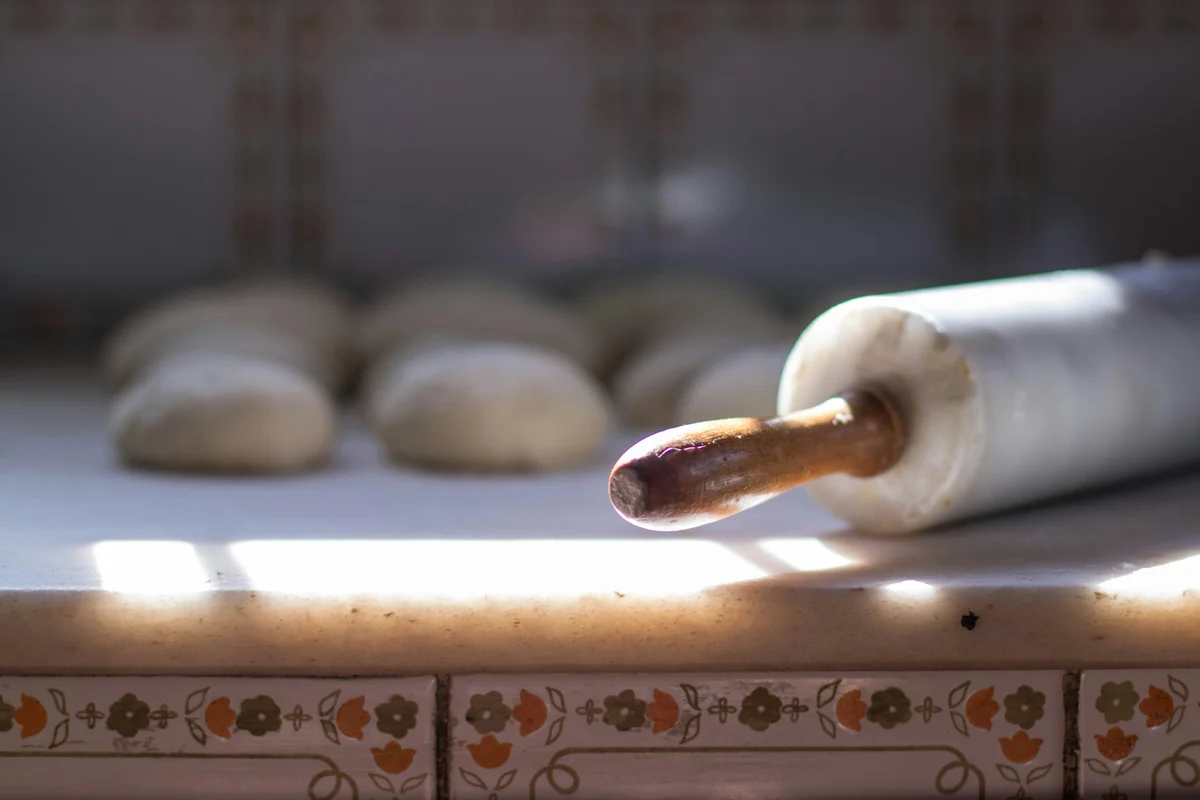
Watching her prepare the dough is like observing a ritual handed down through centuries. The flour — Sicilian durum wheat, golden and slightly coarse — is poured into an ancient wooden maidda, its surface worn by generations of fists and fingers. Water is added gradually, absorbed slowly, respectfully, until the mixture begins to form a living weight beneath her palms.
She pushes the dough with her fists, rhythmically, almost musically, adding only a whisper of oil at the end to make the mixture supple. No additives. No shortcuts. Just patience and a lifetime of instinct. Her son Alfio stands by, explaining how he learned the craft from her, even as modern hospitality and electric mixers have found their place in their home. The wood-fired oven, however, remains sacred.
Eight Hours of Waiting, a Lifetime of Knowing
Once shaped — always by eye, never by measure — the dough is left to rise beneath heavy woollen blankets. In winter it may take eight hours; on warmer days, two or three. Mela shrugs at the timelines. She knows the dough’s needs in the same way one knows the moods of a long-lived friend.
Meanwhile, Alfio prepares the wood-fired oven, using branches from their pruned olive trees. The scent is unmistakable: a deep, earthy perfume that will cling to the bread, giving it the whisper of the countryside. When the heat grows too intense, he splashes a little water inside — a gesture taught by fathers, grandfathers, and those who baked before them.
The Moment of Fire
Before the loaves enter the oven, Mela pierces their surface with a fork — delicate marks that prevent them from swelling wildly. Then, with a practiced sweep, she slides them into the glowing chamber. Ten minutes is often enough. The wood oven, when coaxed correctly, is a powerful ally.
When the bread emerges, it is light, crisp, and resonant with the flavour of good grain. Alfio checks each loaf, recalling his mother’s favourite compliment: “leggio” — light, airy, just right. Bread that isn’t merely baked, but judged by the whisper it makes when tapped.
The Most Ancient Meal: Seasoned Bread
As always, the first loaf is destined for the most elemental of Sicilian traditions: seasoned bread, known locally as pane cunzato. Mela slices it open while it is still hot, its steam escaping like a sigh, and dresses it with their own olive oil, oregano from the surrounding hills, anchovies, and a final pinch of salt.
It is astonishing how a meal so simple can carry the weight of so much history — the toil of early mornings, the stories of families, the scent of volcanic land, the pride of craft. Eating it warm, in Mela’s kitchen, feels like tasting the island’s memory.
A Legacy Baked into Every Crumb
Traditions like this survive not through documentation but through hands — hands that knead, lift, cover, and shape. Mela’s hands, gnarled yet graceful, tell a story far longer than any recipe. And Alfio, with the next generation watching, ensures that these gestures will not be lost.
In Linguaglossa, beneath the watchful gaze of Etna, bread remains more than food. It is continuity. It is belonging. And in the warmth of Mela’s kitchen, one realises that Sicily’s most powerful flavours are not found in restaurants, but in homes where the past is still kneaded into the present, one loaf at a time.
Photo by Sonia Nadales on Unsplash