Overview
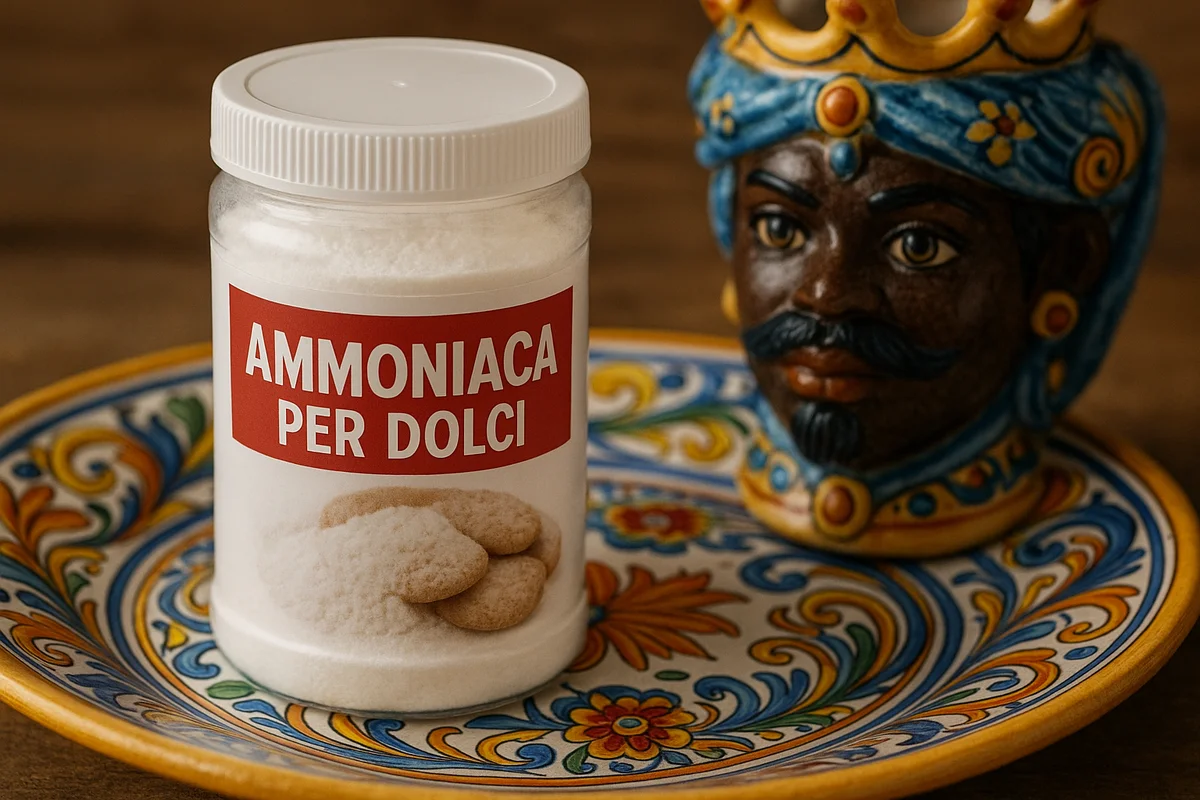
Baker's ammonia, also known as ammonium carbonate or sal volatile, is a traditional leavening agent widely used in Sicilian patisserie, particularly for preparing dry, crisp biscuits. It is a white powder with a distinctive pungent smell that disappears completely during baking.
In Sicilian confectionery tradition, baker's ammonia is the secret ingredient that gives homemade biscuits their unmistakable friable texture, something impossible to achieve with other leavening agents. It is especially valued by experienced pastry cooks who use it to make classic biscuits from the island’s repertoire.
Characteristics
Baker's ammonia is a chemical leavening agent that breaks down completely during baking into gaseous ammonia, carbon dioxide and water vapour. These gases give baked goods an exceptionally light, crisp and friable texture.
Unlike traditional baking powder or bicarbonate of soda, baker's ammonia evaporates entirely during cooking without leaving residues, resulting in more digestible pastries. The strong ammoniac smell released during mixing and baking disappears completely once the product is baked and cooled.
It is important to note that baker's ammonia must be used exclusively in preparations baked at high temperatures and of reduced thickness, such as dry biscuits, to allow the complete evaporation of gases.
Use in cuisine
In Sicilian patisserie, baker's ammonia is used in numerous traditional dry biscuit preparations.
Traditional dry biscuits
Baker's ammonia is essential for making classic Sicilian biscuits such as biscotti regina, mustazzoli, anise biscuits and many other traditional varieties. It gives them the characteristic friability that makes them perfect for dipping in milk or sweet wine.
Almond pastries
In certain traditional versions of almond pastries and amaretti, baker's ammonia is used in small quantities to achieve a lighter, more friable texture while maintaining the characteristic soft interior of these sweets.
Sweet taralli
Sicilian sweet taralli, ring-shaped biscuits glazed with sugar and flavoured with anise or other aromas, owe their crispness precisely to the use of baker's ammonia in the dough.
Tea biscuits
Many dry biscuits served with tea or coffee use baker's ammonia to obtain the crisp, light texture that keeps them from softening too quickly.
Method of use
Baker's ammonia must be used with certain precautions. Before use, it is advisable to dissolve it in a few drops of milk, water or liqueur to facilitate even distribution in the dough and prevent lumps.
Typical quantities range from 5 to 10 grams per kilogram of flour, depending on the type of biscuit desired. It is important not to exceed the recommended amounts to avoid altering the final flavour.
During mixing, a strong smell of ammonia is normal and may be unpleasant. For this reason, it is advisable to work in a well-ventilated environment. The smell disappears completely during baking.
Storage
Baker's ammonia must be stored in an airtight container, in a cool, dry place, away from heat and humidity. When properly stored, it retains its properties for a long time.
The container should always be tightly closed after each use, as baker's ammonia absorbs moisture from the air and may lose effectiveness. If the product develops lumps or appears altered, it is best replaced.
Tips for purchasing
Baker's ammonia is easily found in pharmacies, shops specialising in patisserie supplies or well-stocked grocers. It is important to specify that you need food-grade baker's ammonia, not the household variety, which is unsuitable for baking.
The product is generally sold in 20-gram sachets or small bottles. It is advisable to purchase small quantities at a time to ensure the product is always fresh and effective.
Substitutes and alternatives
If necessary, baker's ammonia may be replaced with baking powder or bicarbonate of soda, although the final result will differ. With baking powder the biscuits will be less friable and softer, while bicarbonate may leave a slight aftertaste.
To maintain greater friability when replacing baker's ammonia, it is advisable to use a combination of baking powder and cream of tartar, which more closely replicates the result obtained with traditional baker's ammonia.
Precautions
Although baker's ammonia is safe when used correctly, certain precautions must be observed. It should never be used in preparations that are not baked or that are cooked at low temperatures, as in such cases the gases would not evaporate fully.
It is not suitable for thick pastries or tall cakes, but only for thin products such as biscuits, which allow complete evaporation during baking. It is essential to respect the recommended quantities in recipes for optimal results.
Curiosities
The use of baker's ammonia in patisserie dates back to ancient times and is widespread throughout Europe, especially in northern countries. In Sicily it became part of local confectionery tradition, becoming an indispensable ingredient in many traditional recipes.
The Sicilian dialect name for baker's ammonia is "spiritu 'i salina" (saltpan spirit), a term derived from the old saltworks where this substance was once produced. Many traditional recipes passed down orally still use this name.
Despite its pungent smell during preparation, baker's ammonia is completely safe and has been used for centuries in baked goods, giving the unique friable texture that characterises the best artisanal Sicilian biscuits.